
TL;DR:
- Choosing genre- and era-appropriate reference tracks ensures accurate mastering benchmarks.
- Using high-resolution files and limited, familiar references improves comparison reliability and efficiency.
- Professional plugins and multi-system listening help achieve consistent, informed mastering decisions.
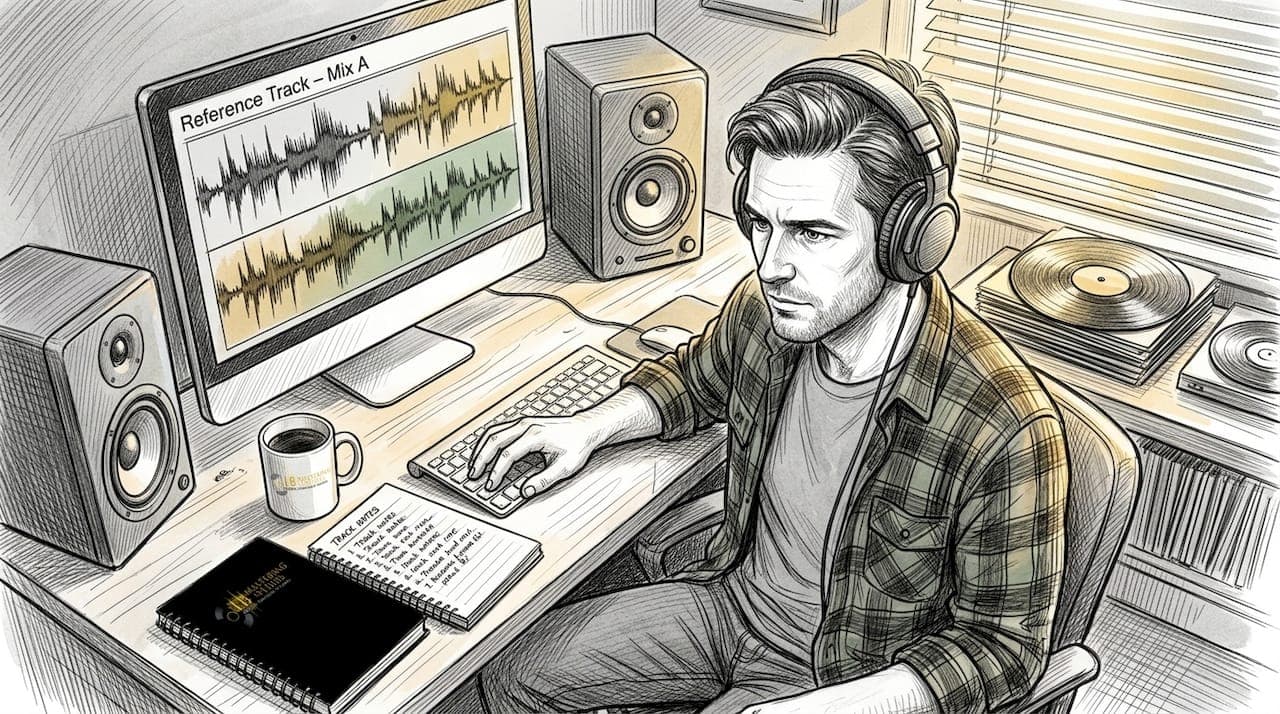
Picking the right reference tracks is harder than it looks. Choosing the wrong ones or using them incorrectly can pull your master in the wrong direction, leaving your music sounding dull, over-compressed, or just plain out of place on streaming platforms. Many independent artists treat reference tracks as an afterthought, dropping in a favorite song and hoping for the best. That approach rarely delivers. This guide walks you through proven criteria for selecting reference tracks, the most effective plugins for comparison, real-world pro workflows, and honest advice on which referencing strategy actually fits your experience level and goals.
Table of Contents
- The criteria for choosing the best mastering reference tracks
- Top tools and plugins for effective referencing
- How leading pros actually use references during mastering
- Comparing reference approaches: Physical vs digital, broad vs targeted libraries
- Why most artists misuse reference tracks—and what really works
- Level up your mastering with professional insights and resources
- Frequently asked questions
Key Takeaways
| Point | Details |
|---|---|
| Reference selection matters | Carefully chosen reference tracks set the benchmark for music mastering clarity and style. |
| Essential toolbox | Modern plugins make referencing fast and reveal sonic details missed by ear alone. |
| Pro workflow insights | Leading engineers use references deliberately and build habits that maximize the benefits without over-relying on A/B checks. |
| Adapt your approach | Adjust your reference library and workflow as your mastering skills advance and your sonic goals evolve. |
| Real-world results | Focusing on reference strategies that fit your unique context leads to pro-level masters and more satisfying releases. |
The criteria for choosing the best mastering reference tracks
Having framed why reference tracks are essential, let's lay out what to actually look for in the ideal options. The right reference track doesn't just sound good. It serves as a precise, genre-appropriate benchmark that helps you make confident, objective decisions during mastering.
Start with genre and production era. A trap record from 2023 is going to have wildly different frequency distribution, loudness targets, and transient handling than a folk record from 2008. Matching genre is the most important filter. Production era matters too because loudness standards, low-end treatment, and stereo width have all shifted over time. Pick tracks that are current enough to reflect today's streaming-normalized reality, especially if you're targeting Spotify, Apple Music, or Tidal.
Next, consider instrument treatment and vocal clarity. If your mix features bright lead vocals and layered harmonies, choose references with similar arrangements. Listen closely to how the vocals sit in the frequency spectrum. Are the consonants clear without being harsh? Does the low-end sit under the vocals or compete with them? These specific characteristics matter more than how "big" a track sounds overall.
Here's what to look for when building your reference library:
- Choose tracks you know intimately. Familiarity is the foundation of useful referencing.
- Use only high-resolution WAV or AIFF files, not MP3s. Lossy compression distorts frequency response and loudness, making them unreliable for critical comparison.
- Confirm how a track sounds after streaming normalization before locking it in as a reference. Platforms like Spotify normalize to around negative 14 LUFS (Loudness Units relative to Full Scale), which can affect perceived tonal balance.
- Aim for a focused library of 5 to 10 tracks rather than a sprawling playlist. A smaller set means you learn each reference deeply, which makes comparisons faster and more reliable.
- Prioritize tracks mastered at professional facilities, ideally ones you can verify were released on major labels with dedicated mastering credits.
Pro Tip: Some seasoned engineers use references sparingly to avoid distraction, and experienced pros often store a mental image of a reference's sound rather than pulling it up every session. As a beginner or intermediate engineer, keep a physical list and access it regularly until you've built that internal library.
Pairing clear selection criteria with a solid professional mastering guide sets a strong foundation. Once you know what to choose, make sure your workflow keeps up by keeping a mastering checklist close by for every session.
Top tools and plugins for effective referencing
With selection criteria mapped out, let's walk through industry-standard tools that make referencing seamless and precise. The right plugins eliminate guesswork and give you measurable data to work with instead of relying entirely on subjective listening.
Metric AB is one of the most widely used referencing plugins available. It lets you load multiple reference tracks directly into your session, instantly A/B between your master and the references, and match loudness levels automatically. Loudness matching is critical because louder tracks always sound "better" to our ears, even when they aren't. Metric AB removes that bias.
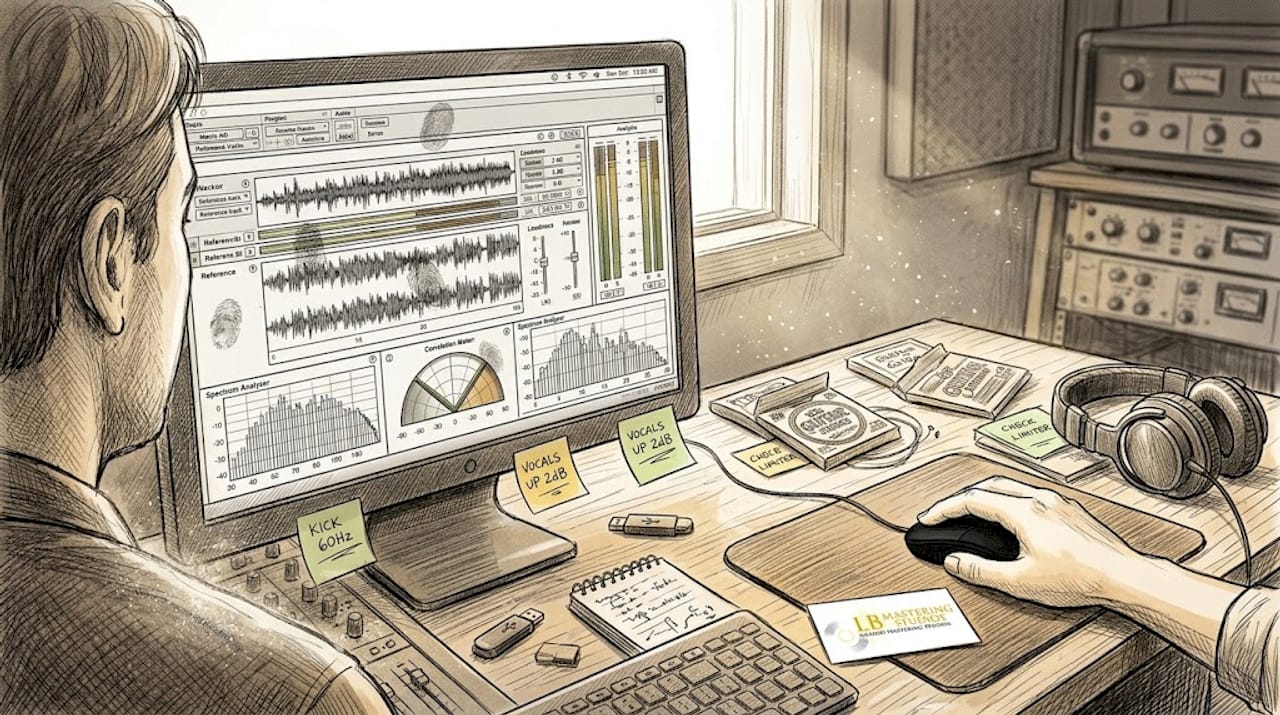
Mastering the Mix REFERENCE takes things further with a "trinity display" that visualizes tone, punch, and width simultaneously. You can see at a glance whether your master's low-end punch, midrange tone, and stereo width align with your reference. It's an especially powerful tool for independent musicians who are still developing their listening skills, because the visual display reinforces what your ears are hearing.
FabFilter Pro-Q 3's EQ Match function analyzes the frequency curve of a reference and generates an EQ curve that narrows the gap between your master and the reference. This doesn't mean you blindly apply the curve, but it gives you a roadmap of where the differences are concentrated.
BASSROOM and MIXROOM from Mastering the Mix target specific frequency ranges, with BASSROOM focused on low-end clarity in mastering and MIXROOM addressing mid and high-frequency targets relative to a chosen reference. Both use AI-assisted analysis to generate targets based on genre.
| Plugin | Primary function | Best for |
|---|---|---|
| Metric AB | A/B loudness-matched comparison | All levels |
| Mastering the Mix REFERENCE | Tone, punch, and width visualization | Beginners to intermediate |
| FabFilter Pro-Q 3 EQ Match | Frequency curve matching | Intermediate to advanced |
| BASSROOM | Low-end referencing | Bass-heavy genres |
| MIXROOM | Mid/high referencing | Vocal and mix clarity |
Beyond plugins, always check your master on varied playback systems. Your studio monitors are just one data point. Listen on laptop speakers, earbuds, a phone in speaker mode, and a car stereo. References that sound balanced across all systems are your gold standard. As noted in research on creating reference CDs, tools like spectrum analyzers combined with auto-matching plugins give you the most consistent and repeatable workflow.
Here's a practical sample workflow: load your reference into Metric AB, match loudness to your master, then use REFERENCE to check the trinity display. Use Pro-Q's EQ Match to identify frequency imbalances. Make targeted adjustments. Recheck on three different playback systems before finalizing.
Pro Tip: Run your reference track through the same playback path as your master, including your DAW's output and your audio interface. Different signal paths color the sound, and even small differences can mislead your comparisons. For more detail on the gear shaping these results, explore mastering equipment examples that professionals rely on.
How leading pros actually use references during mastering
Now that you're equipped with the right tools, it's time to mimic the habits of trusted mastering engineers. Knowing when to check references is just as important as knowing what to check.
Here's the sequence that leading engineers follow:
- At session start: Pull up your reference before you make a single adjustment. Listen critically, then switch to your master. This calibrates your ears to the target and prevents you from chasing your own assumptions.
- After the static balance: Once you've set initial gain staging and made broad EQ moves, check the reference again. This is where tonal imbalances often reveal themselves most clearly.
- After extended listening breaks: Your ears fatigue fast. A fresh listen after a break followed immediately by a reference check often reveals problems you missed, especially in the upper midrange and low-end clarity.
- Before final export: One last reference check ensures you haven't drifted from your target during fine-tuning stages.
"Reference at the session start, after breaks, and after your static balance. Listen at varied volumes and systems. Apply broad EQ first, and if you need more than 4dB of correction, the problem is in the mix, not the master." Sound on Sound
This point about EQ correction exceeding 4dB is one of the most practical takeaways for independent musicians. If you're comparing your master to a reference and finding you need enormous EQ shifts to match it, that signals a mix problem. Mastering works best as a final polish, not a rescue operation. Chasing a reference with heavy-handed EQ will compress dynamics and introduce phase issues that compromise your overall sound.
Monitor at different volumes too. Low-volume listening reveals whether your midrange is balanced. High-volume checks expose harshness and low-end mud. The essential mastering steps most professionals follow include multi-volume reference checks as a non-negotiable part of the workflow.
Avoid the trap of over-referencing. Checking your master against references every few minutes pulls your focus toward replication instead of artistic decision-making. The most skilled engineers use references as occasional anchors, not constant guardrails. Visit the mastering tips blog for ongoing advice on building disciplined, professional mastering habits.
Comparing reference approaches: Physical vs digital, broad vs targeted libraries
All referencing methods aren't equal. Next, let's evaluate which approach sets you up for the results you want.
Physical referencing using CDs or vinyl still has advocates among veteran engineers. A well-pressed CD eliminates streaming normalization as a variable and gives you bit-accurate playback. Vinyl referencing is primarily useful for vinyl-specific projects, where engineers need to check that low-end mono compatibility and dynamic range work within the format's physical constraints. For most independent musicians working digitally, CDs remain a solid reference option if you can confirm the disc is an authentic master pressing and not a remaster.
Digital file referencing is faster and more flexible. High-resolution WAV files (24-bit, 44.1kHz or higher) are the standard for modern digital referencing. The risk is file provenance: there's no guarantee a WAV you've downloaded is the same master that appeared on a major label release. Stick to files ripped directly from original CDs or downloaded from official hi-res platforms.
| Approach | Strengths | Weaknesses |
|---|---|---|
| Physical CD | Bit-accurate, no streaming normalization | Slower, limited portability |
| Vinyl | Reveals format-specific mastering issues | Only relevant for vinyl projects |
| Digital WAV | Fast, flexible, integrates with plugins | Risk of uncertain file provenance |
| Streaming | Reflects real-world listener experience | Affected by normalization and compression |
Here's how to match your library approach to your experience level:
- Beginners: Build a small, tightly focused library of 5 to 7 genre-matched tracks in WAV format. Use plugin-based referencing tools to visualize comparisons.
- Intermediate engineers: Expand to 8 to 10 tracks spanning sub-genres and production eras. Start developing your ability to hold a sonic image mentally between sessions.
- Advanced engineers: Use references sparingly and rely on deeply internalized sonic targets for most decisions, pulling references mainly to sanity-check major tonal shifts.
Why does a smaller library work better? The answer comes down to depth of familiarity. You want to know each reference track like you know your own name. When you've heard a track hundreds of times, you hear deviations immediately. A huge playlist of 40 references gives you breadth but no depth, and breadth doesn't help when you're making micro-decisions about high-frequency air or low-mid warmth.
Understanding optimal mastering loudness targets for each streaming platform is essential when using digital references. Pairing that knowledge with resources on how to maximize loudness effectively ensures your references reflect realistic, platform-ready targets rather than an idealized standard that doesn't translate to real-world playback.
Why most artists misuse reference tracks—and what really works
Here's a candid observation from our years of experience: the artists who struggle most with mastering are often the ones checking references the most. Over-reliance on A/B comparisons creates a feedback loop of second-guessing rather than confident, decisive action. Instead of asking "does this sound right to me?" the engineer starts asking "does this sound like that?" Those are very different questions, and the second one often leads you away from the music's original identity.
The artists who get breakthrough results are those who use references to calibrate their ears at the start of a session, then step back and let their informed instincts guide the actual work. References are a compass, not a script. Developing clarity in mastering means trusting your calibrated perception to make micro-decisions without constant external validation.
The real goal is to eventually develop such a refined internal reference that you need fewer external checks, not more. That takes time and intentional practice, but every session is an opportunity to move in that direction.
Level up your mastering with professional insights and resources
To put these lessons into action and achieve the sound you hear in your head, explore the resources and professional options available through LB-Mastering Studios.
We offer access to a full suite of analog and digital mastering equipment designed to give your recordings the warmth, clarity, and competitive loudness they deserve. Download our audio mastering checklist PDF to keep your sessions structured and goal-focused from start to finish. And if you're ready for results that go beyond what plugins alone can achieve, our professional CD mastering services deliver Grammy-level precision with personalized engineer communication at every step. Let us help you bring your vision to life with the quality it deserves.
Frequently asked questions
How many reference tracks should I use when mastering a song?
A focused library of 5 to 10 carefully chosen tracks is ideal for effective referencing without distraction. Familiarity with each track matters far more than the size of the collection.
At what stage should I compare my master with reference tracks?
Check references at the session start, after the static balance, and again after listening breaks for the most accurate perspective. Each check serves a distinct purpose in your workflow.
Which plugins help with mastering reference track comparison?
Plugins like Metric AB and REFERENCE offer auto loudness-matching and real-time visual feedback, while FabFilter Pro-Q's EQ Match identifies specific frequency gaps between your master and the reference. Using them together gives you both qualitative and quantitative data.
Why does my master sound different on streaming platforms compared to my DAW?
Streaming normalization and lossy compression can alter perceived loudness and tonal balance significantly. Always reference the post-upload sound on the actual platform before declaring a master finished.
Should I reference exclusively in my genre or include outside tracks?
Genre-matching is the most important factor for consistency and competitive loudness targets, but occasionally listening to masters from outside your genre can expose you to creative approaches to dynamics, stereo width, and tonal balance that can improve your overall ear training.