
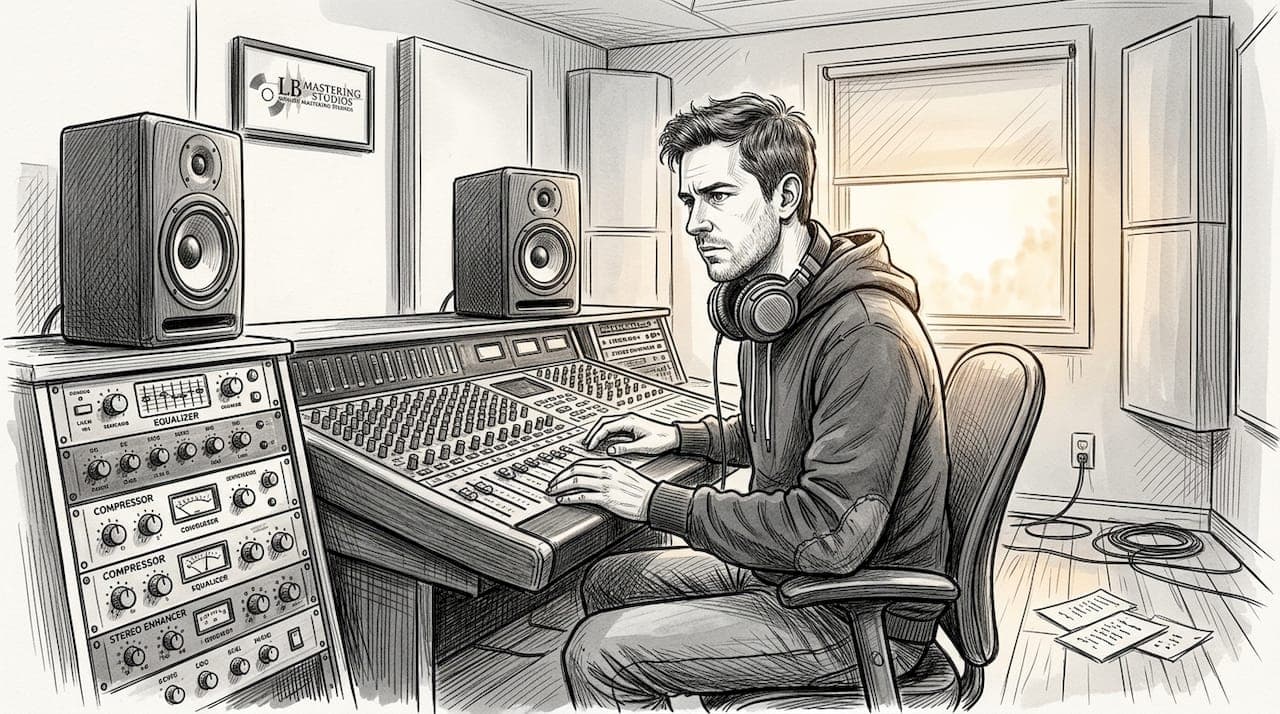
Many musicians believe cranking up the volume during mastering automatically makes their tracks sound better. This misconception leads to distorted, fatiguing audio that fails to translate well across different playback systems. Proper loudness mastering requires understanding technical measurements, platform-specific standards, and careful balance between perceived volume and audio quality. This guide provides independent musicians and record labels with expert strategies to achieve optimal loudness mastering that ensures consistent, high-quality playback across all streaming platforms and devices in 2026.
Table of Contents
- Understanding Loudness In Music Mastering
- Comparing Loudness Standards Across Streaming Platforms
- Techniques To Maximize Loudness Without Sacrificing Quality
- Common Pitfalls And How To Avoid Them In Loudness Mastering
- How LB-Mastering Can Help You Master Loudness For 2026
Key takeaways
| Point | Details |
|---|---|
| Optimal loudness balances volume and quality | Proper mastering maintains clarity and dynamics while achieving competitive loudness levels |
| Platform standards require specific approaches | Each streaming service has unique loudness targets that shape mastering decisions |
| Technical measurements guide decisions | LUFS and True Peak meters provide objective data for consistent results |
| Effective mastering prevents distortion | Careful processing enhances impact without introducing unwanted artifacts |
| Understanding improves listener experience | Knowledge of loudness principles ensures tracks sound great on all playback systems |
Understanding loudness in music mastering
Loudness in professional mastering refers to the perceived volume of audio over time, measured in loudness units relative to full scale (LUFS). Unlike simple peak volume, which only captures the highest momentary level, LUFS accounts for how humans actually perceive sound intensity across the frequency spectrum. This distinction matters because two tracks with identical peak levels can sound dramatically different in terms of perceived loudness.
True Peak metering complements LUFS measurements by detecting inter-sample peaks that can cause distortion during digital-to-analog conversion. These peaks occur between sample points and may not register on traditional peak meters, yet they create clipping on consumer playback devices. Monitoring True Peak values prevents this hidden distortion, ensuring your masters translate cleanly across all systems.
Streaming platforms apply loudness normalization to create consistent playback experiences for listeners. When you upload a track, the service analyzes its integrated LUFS and adjusts playback gain accordingly. A track mastered too loud gets turned down, while quieter tracks get boosted. Understanding this process helps you make informed decisions about target loudness levels during mastering.
Several key parameters impact mastering decisions:
- Integrated LUFS measures average loudness across the entire track
- Short-term LUFS captures loudness over three-second windows
- Momentary LUFS tracks loudness in 400-millisecond segments
- True Peak indicates the highest inter-sample peak value
Mastering these measurements enables you to achieve predictable results across different platforms. You can anticipate how normalization will affect your tracks and adjust your mastering approach to maintain the intended sonic character after platform processing.
Comparing loudness standards across streaming platforms
Each major streaming service implements different loudness normalization targets, requiring strategic mastering decisions to optimize playback across platforms. Understanding these variations helps you choose appropriate mastering levels that work well everywhere without compromising quality.
| Platform | Target LUFS | True Peak Limit | Notes | | --- | --- | --- | | Spotify | -14 LUFS | -1 dBTP | Turns down louder tracks, leaves quieter ones unchanged | | Apple Music | -16 LUFS | -1 dBTP | More conservative target preserves dynamics | | YouTube | -13 to -14 LUFS | -1 dBTP | Varies by content type and user settings | | Tidal | -14 LUFS | -1 dBTP | Similar to Spotify normalization | | Amazon Music | -14 LUFS | -2 dBTP | Stricter True Peak requirement |
When platforms normalize your audio, they apply gain adjustments to match their target loudness. If your master exceeds the target, the service reduces playback volume. This attenuation preserves your original dynamic relationships but results in lower overall volume compared to tracks mastered closer to the target. Conversely, tracks mastered below the target may receive upward gain, though some services only turn down, never up.
Choosing the right mastering loudness involves balancing multiple considerations. Mastering at exactly -14 LUFS integrated works well for Spotify and Tidal but may sound slightly louder than intended on Apple Music. Aiming for -15 to -16 LUFS provides headroom for platform variations while maintaining competitive loudness.
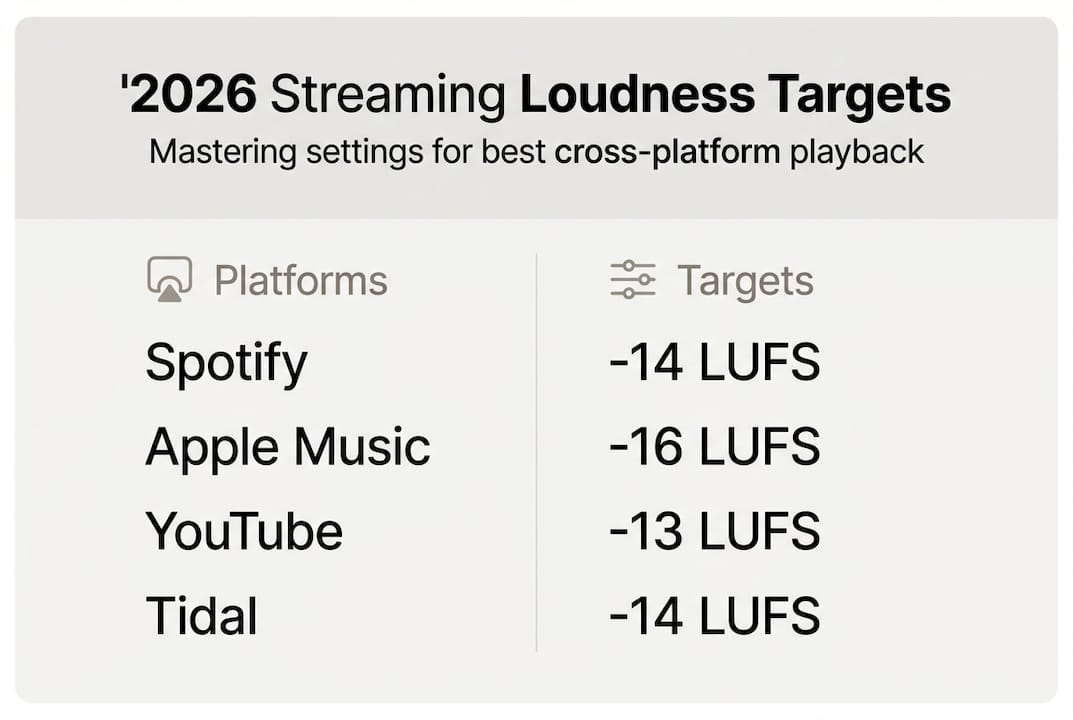
True Peak limits prevent clipping during codec conversion and playback. Most platforms specify -1 dBTP maximum, though Amazon Music requires -2 dBTP. Exceeding these limits can cause distortion even if your master sounds clean in your studio. Always check True Peak readings across your entire mix, not just at the loudest sections.
Pro Tip: Master your tracks to -15 LUFS integrated with -1 dBTP True Peak maximum to ensure compatibility across all major streaming platforms while preserving dynamic range and preventing post-normalization distortion.
Techniques to maximize loudness without sacrificing quality
Achieving competitive loudness while maintaining clarity and professional sound quality requires a systematic approach to audio processing. The order of your mastering chain significantly impacts the final result and determines how effectively you can increase perceived volume.
- Start with corrective equalization to address frequency imbalances and remove problematic resonances before applying dynamics processing
- Apply broad-stroke compression to control overall dynamic range and create a more consistent foundation for further processing
- Use multiband compression to manage frequency-specific dynamics, taming harsh highs or tightening loose low end independently
- Add enhancement equalization to shape the final tonal character and add presence or air as needed
- Apply limiting as the final step to achieve target loudness while preventing peaks from exceeding True Peak limits
Multiband compression provides surgical control over different frequency ranges without affecting the entire mix. You can compress aggressive low frequencies to create headroom for limiting while leaving delicate high-frequency transients untouched. This frequency-specific approach prevents the pumping artifacts that occur when broadband compression reacts to bass-heavy sections.
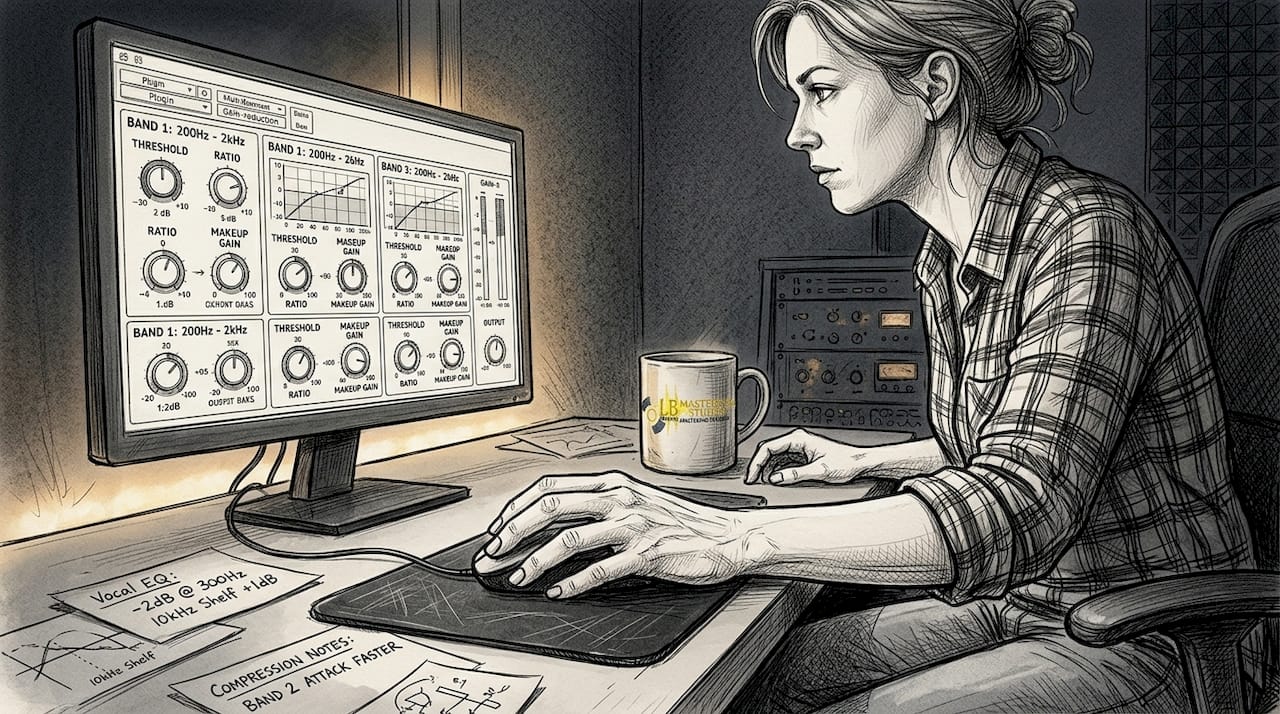
Preserving transients maintains the punch and impact that makes music exciting to listen to. Fast attack times on compressors and limiters can dull drum hits and other percussive elements, reducing the energy of your mix. Using moderate attack times or parallel compression techniques allows transients to pass through relatively unaffected while still controlling the body of sounds.
Monitor your LUFS and True Peak meters continuously throughout the mastering process. Check integrated LUFS to ensure you're approaching your target range, but also watch short-term and momentary readings to identify sections that may cause problems. True Peak metering should remain active on your master bus to catch inter-sample peaks before they become issues.
Over-limiting creates the dreaded brickwall effect where all peaks get squashed to the same level, eliminating dynamics and causing listener fatigue. When every element in a mix reaches maximum volume simultaneously, the result sounds flat and exhausting. Modern listeners prefer tracks with some dynamic variation, even at competitive loudness levels.
Pro Tip: Route a copy of your mix to a parallel compression bus with aggressive settings, then blend it subtly with the original to add density and perceived loudness without destroying transients or creating obvious pumping artifacts.
Common pitfalls and how to avoid them in loudness mastering
Even experienced engineers make mistakes when pursuing competitive loudness levels. Understanding these common errors helps you avoid compromising your audio quality in the pursuit of volume.
Frequent loudness mastering mistakes include:
- Applying excessive compression that removes all dynamic variation and creates a lifeless sound
- Ignoring True Peak readings and focusing solely on sample peak meters
- Failing to account for platform normalization when choosing target loudness levels
- Using extreme limiting settings that introduce audible distortion and artifacts
- Not referencing your masters on multiple playback systems before finalizing
Over-compression ranks as the most damaging mistake in loudness mastering. When you squeeze every ounce of dynamic range from a mix, you eliminate the contrast between loud and soft elements that creates musical interest. The result sounds dense and fatiguing, causing listeners to turn down the volume or skip to the next track. Excessive loudness processing causes distortion, reduced dynamics, and listener fatigue that undermines your artistic intent.
Ignoring platform normalization leads to misguided mastering decisions. Some engineers push their masters to -8 or -9 LUFS integrated, believing louder always wins. However, streaming services turn these hot masters down to match their target levels, negating any loudness advantage while preserving the compressed, distorted character. You end up with a dynamically limited master that plays back at the same volume as a more dynamic -14 LUFS version.
"The loudness wars taught us that chasing maximum volume at all costs destroys music. Smart mastering in 2026 means understanding platform standards and optimizing for perceived loudness within those constraints, not fighting against them."
Best practices for avoiding these pitfalls start with setting realistic loudness targets based on your genre and intended platforms. Reference commercially successful tracks in your style to understand what competitive loudness sounds like without crossing into over-processing territory. Use quality monitoring systems that reveal subtle distortion and compression artifacts you might miss on consumer speakers.
Test your masters on various playback systems before considering them final. Listen on studio monitors, consumer headphones, smartphone speakers, car audio systems, and laptop speakers. Each system reveals different aspects of your master and may expose problems invisible in your primary monitoring environment. Upload test versions to streaming platforms and check how normalization affects your tracks in real-world conditions.
Regularly compare your in-progress master to the unprocessed mix. This A/B comparison keeps you honest about whether your processing genuinely improves the sound or simply makes it louder. If you can't articulate specific improvements beyond increased volume, you may be over-processing.
How LB-Mastering can help you master loudness for 2026
Achieving optimal loudness for modern streaming platforms requires both technical knowledge and experienced ears. LB-Mastering Studios brings over 44 years of industry expertise to every project, helping independent musicians and record labels navigate the complexities of loudness mastering in 2026. Our Grammy-winning mastering engineers understand how to balance competitive volume with the clarity and dynamics that make music engaging.
We provide a free audio mastering checklist that guides you through preparing your mixes for optimal loudness processing. Our hybrid signal chain combines vintage analog and digital equipment to achieve warmth and punch while meeting technical specifications for all streaming platforms. Working as an online mastering studio serving clients worldwide, we deliver professional results with personalized service regardless of your location. Contact us today to discuss how we can help your music achieve its full sonic potential across all playback systems.
FAQ
What is loudness normalization, and why does it matter?
Loudness normalization adjusts playback volume to consistent levels across tracks and platforms, creating a better listening experience by preventing jarring volume changes between songs. Streaming services analyze the integrated LUFS of uploaded tracks and apply gain adjustments to match their target loudness standards. Understanding optimal loudness mastering helps you anticipate these adjustments and master your music accordingly, ensuring it sounds as intended after normalization rather than getting turned down or losing impact.
How loud should I master my music for streaming in 2026?
Most streaming platforms target approximately -14 LUFS integrated loudness for optimal playback, though Apple Music uses a more conservative -16 LUFS standard. Mastering between -15 and -16 LUFS integrated provides a safe middle ground that works well across all services while preserving dynamic range. Always maintain True Peak levels at or below -1 dBTP to prevent distortion during codec conversion. Check the mastering tips and industry blog for platform-specific recommendations and current best practices as standards evolve.
Can I increase loudness too much during mastering?
Excessive loudness processing reduces dynamic range, introduces distortion, and causes listener fatigue that makes people turn down the volume or stop listening entirely. When you push limiting and compression beyond reasonable levels, you sacrifice the musical qualities that make tracks engaging and memorable. Balance competitive loudness with clarity and dynamics for best results. Learn about avoiding loudness pitfalls to understand where to draw the line between competitive volume and over-processing that damages your music's impact and longevity.