
TL;DR:
- Mastering is essential for listener engagement and algorithmic success, not just a final touch.
- Proper mastering ensures platform compatibility, optimal loudness, and sonic clarity across all formats.
- Focusing on feeling and genre-appropriate loudness helps develop a compelling release that performs well digitally.
Most independent artists treat mastering as a finishing touch, something cosmetic you add before uploading to DistroKid or TuneCore. That assumption is costing you streams. Over-limited tracks show 22% higher skip rates on major platforms, and that data directly impacts how algorithms decide whether to push your music or bury it. Mastering is not decoration. It is the technical and sonic bridge between your finished mix and every listener's ears, on every platform, in every format. This guide breaks down exactly how mastering affects your distribution outcomes and what you can do about it.
Table of Contents
- Why mastering matters for modern music distribution
- Key mastering elements that affect distribution
- Common pitfalls: Mastering mistakes that hurt your reach
- Best practices: How to master for platform-ready distribution
- A mastering engineer's view: What really moves the needle in distribution
- Elevate your releases with pro mastering
- Frequently asked questions
Key Takeaways
| Point | Details |
|---|---|
| Mastering influences streaming success | Proper mastering boosts engagement and playlist opportunities by optimizing your track for platform requirements. |
| Match mastering to platform and genre | Tailor your loudness, peak levels, and formatting to each streaming service and genre for best results. |
| Avoid common mastering pitfalls | Over-limiting or poor file prep can increase skips and lower your ranking in streaming algorithms. |
| Workflow and equipment matter | Consistent use of a proven mastering process and quality gear elevates tracks for both listeners and algorithms. |
| No single standard for all | Genre, service, and audience expectations mean mastering choices should be flexible, not one-size-fits-all. |
Why mastering matters for modern music distribution
With misconceptions laid bare, let's explore why mastering truly sets the foundation for modern streaming success.
Mixing balances your elements. Mastering prepares your track for the real world. These are two completely different jobs, and confusing them is one of the most common mistakes independent artists make. A great mix can still fail at the distribution stage if it hasn't been properly mastered for platform compatibility, loudness normalization, and codec encoding.
Here is what professional mastering actually achieves that mixing cannot:
- Loudness normalization readiness: Platforms like Spotify and Apple Music automatically adjust playback volume. A poorly mastered track gets turned down unevenly, creating a thin or distorted result.
- Codec preparation: Streaming services encode your audio into lossy formats like AAC or Ogg Vorbis. Mastering shapes the signal so it survives that compression without losing clarity.
- Tonal balance: A well-mastered track sounds consistent across earbuds, car speakers, and studio monitors, which directly affects listener engagement.
- True peak control: Keeping true peak levels in check prevents clipping during encoding, which introduces audible distortion.
The loudness war in streaming has fundamentally changed what "loud" means. Platforms normalize everything, so pushing your master louder than the target does not make it sound louder to listeners. It just makes it sound worse. Tracks mastered over-loud show a 22% higher skip rate and lower playlist retention. That is not a minor penalty. That is algorithmic death.
"The goal is not to maximize loudness. The goal is to maximize impact. Those are very different targets."
When listeners skip your track in the first 30 seconds, platforms interpret that as a signal that your music is not worth promoting. Skip rate directly influences algorithmic playlist placement, radio features, and recommendation engine behavior. Mastering is the single biggest technical lever you control at the distribution stage.
Pro Tip: Stop staring at your meters and start using your ears. Run your master through a reference track that is performing well in your genre right now. If yours sounds thin, harsh, or fatiguing by comparison, the problem is in the mastering, not the mix. You can also review a solid mastering steps checklist to make sure you are not skipping critical prep steps before export.
The goal is to maximize loudness intelligently, not aggressively. Density, punch, and clarity matter far more than raw level numbers.
Key mastering elements that affect distribution
Having established mastering's crucial role, let's pinpoint which elements matter most in preparing for distribution.
Not all mastering decisions carry equal weight when it comes to platform performance. Some technical choices directly determine whether your track encodes cleanly, plays back correctly, and competes sonically in its genre category.
Loudness targets by genre
Different genres have different listener expectations and different platform behaviors. Here is a practical reference:
| Genre | Recommended integrated LUFS | Notes |
|---|---|---|
| EDM / Electronic | -6 to -9 LUFS | High density, minimal dynamic range |
| Pop | -8 to -10 LUFS | Balanced punch and clarity |
| Hip-hop / R&B | -8 to -10 LUFS | Emphasis on low-end weight |
| Rock / Alternative | -9 to -12 LUFS | Transient preservation matters |
| Classical / Acoustic | -16 to -20 LUFS | Wide dynamics, natural feel |
These are starting points, not rules. Genre differences in LUFS and codec-induced clipping risks are well-documented, and the best mastering engineers use these targets as context, not constraints.
True peak and codec safety
True peak is not the same as sample peak. When your audio is encoded into a lossy format, inter-sample peaks can cause clipping even if your waveform looks clean. The standard recommendation is to keep true peak below -1 dBTP. For tracks going to multiple platforms simultaneously, some engineers push that to -1.5 dBTP to add a safety margin.

Pro Tip: Always export your final master at 24-bit WAV before uploading to any distributor. This gives the platform's encoder the cleanest possible source material. Check the optimal mastering loudness targets for each platform before you finalize your settings.
Format preparation matters
If you are releasing to CD as well as streaming, the requirements differ significantly. CD mastering differences in format, bit depth, and peak handling mean you should never use the same master file for both without adjustments. Lossless formats reveal every flaw that lossy encoding might have hidden.
- Deliver 44.1 kHz / 16-bit WAV for CD and standard streaming
- Deliver 24-bit FLAC for high-resolution platforms
- Always request a DDP file set for CD replication projects
Common pitfalls: Mastering mistakes that hurt your reach
Knowing what to target helps, but understanding what to avoid is just as critical for a successful release.
Even technically competent producers make mastering mistakes that quietly sabotage their distribution results. These errors do not always sound obvious in isolation. They reveal themselves in skip rates, listener fatigue, and reduced algorithmic reach.
Here are the top 5 mastering mistakes that limit your distribution reach:
- Over-limiting your master. Over-limiting does not translate to louder playback after normalization. Instead, it sacrifices the dynamics that make music feel alive and engaging.
- Ignoring true peak. Submitting a master with true peaks above -1 dBTP causes codec clipping, which introduces distortion that listeners notice even if they cannot name it.
- Skipping format-specific exports. Using the same WAV file for Spotify, CD, and vinyl is a shortcut that costs you quality on every format.
- Referencing only on studio monitors. If you never check your master on earbuds, a phone speaker, or a car stereo, you are missing how most listeners will actually hear it.
- Treating mastering as volume adjustment only. Mastering includes tonal shaping, stereo width control, and dynamic management. Volume is just one output of a much larger process.
"Dynamics are not a weakness in your master. They are the reason listeners feel something when the chorus hits."
The algorithmic consequences are real. Tracks with poor mastering quality get higher skip rates and less algorithmic and personalized playlist placement. That means fewer editorial pitches, fewer Discover Weekly appearances, and fewer organic streams over time.
Poor mastering also affects how your music is perceived by playlist curators who review submissions manually. A harsh, fatiguing, or dynamically crushed master signals a lack of professionalism, regardless of how strong the songwriting is. Review the pro mastering steps that experienced engineers use to avoid these outcomes before your next release.
Best practices: How to master for platform-ready distribution
Having covered common mistakes, let's shift to solutions, with clear actions for platform-ready mastering.
A distribution-ready master is not just technically correct. It is optimized for the specific platforms where your audience listens. Here is a practical workflow to get there.
Step-by-step mastering prep
- Export your mix at 24-bit, 48 kHz or higher with at least 3 to 6 dB of headroom before mastering begins
- Check your integrated LUFS against the genre targets listed above
- Verify true peak stays below -1 dBTP on all exports
- Reference your master against two or three recently playlisted tracks in your genre
- Create separate exports for streaming, CD, and vinyl if applicable
Platform comparison: Distribution requirements
| Platform | Preferred format | Loudness target | True peak limit |
|---|---|---|---|
| Spotify | 16-bit WAV / OGG | -14 LUFS (normalized) | -1 dBTP |
| Apple Music | 24-bit AAC / ALAC | -16 LUFS (normalized) | -1 dBTP |
| Tidal / HiFi | 24-bit FLAC | -14 LUFS | -1 dBTP |
| YouTube Music | AAC 256 kbps | -13 LUFS | -1 dBTP |
| Amazon Music HD | 24-bit FLAC | -14 LUFS | -1 dBTP |
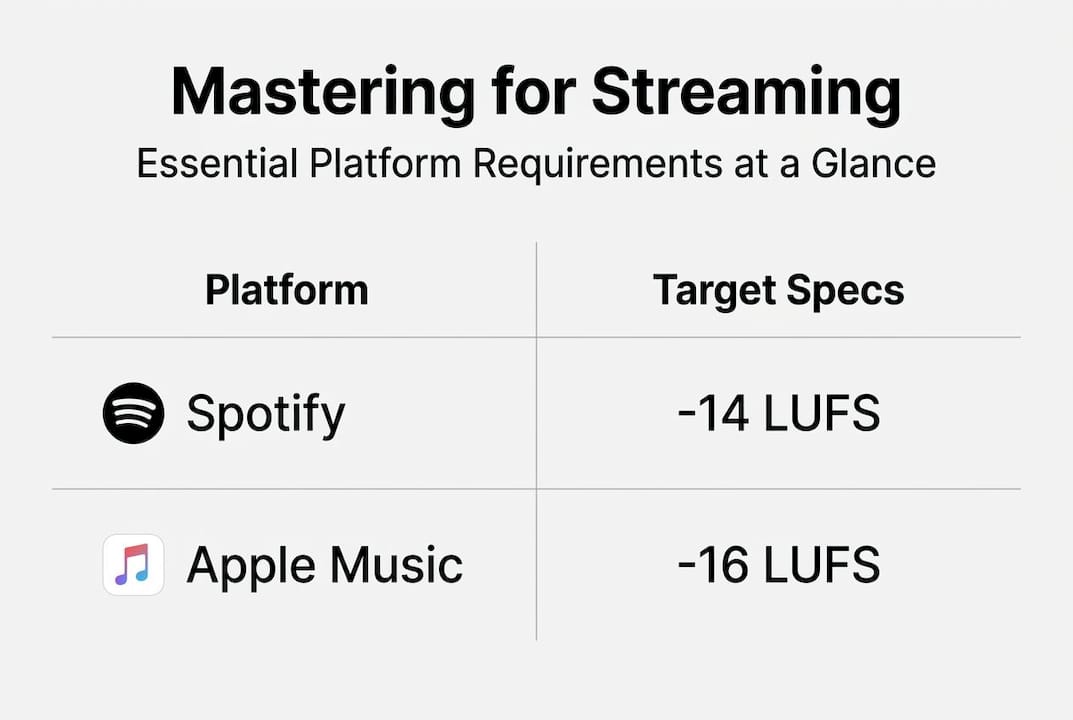
Spotify HiFi and lossless tiers require 24-bit FLAC and will expose compression artifacts if mastering is not carefully executed. This is not a future concern. It is a current reality for any artist releasing to high-resolution platforms.
Pro Tip: Pull three tracks from a curated playlist in your genre that were added in the last 60 days. A/B your master against them at matched loudness. If yours sounds smaller, harsher, or less clear, identify which frequency range is causing the problem before you upload.
The right mastering equipment examples make a measurable difference in how well a master translates across formats. But equipment alone is not enough. Objective feedback from a second set of trained ears remains one of the most reliable ways to catch problems before distribution. A complete step-by-step mastering checklist can help you build consistency into every release you put out.
A mastering engineer's view: What really moves the needle in distribution
Having mapped the hands-on process, here is a candid look from an insider's perspective.
After decades of working with artists across every genre, we have seen one pattern repeat itself: artists obsess over hitting a specific LUFS number and miss the bigger picture entirely. There is no strict loudness standard that guarantees success. Genre-appropriate density and psychoacoustics matter more than hitting a target LUFS.
What actually moves the needle is whether your master makes a listener feel something in the first eight seconds. That is a combination of tonal balance, transient response, stereo image, and emotional intent. None of those are captured by a meter reading.
"Master for the listener, not the loudness meter."
The artists whose releases perform best algorithmically are not the ones with the loudest masters. They are the ones whose masters feel right for the genre, the mood, and the moment. Dynamics create tension. Tension creates engagement. Engagement drives saves, shares, and playlist adds. That is the chain that actually matters. Chase the feeling, not the number.
Elevate your releases with pro mastering
When you're ready to bring your music to every platform at its best, here's how to get expert support.
At LB-Mastering Studios, we have spent over 44 years preparing tracks for distribution across every format and every platform. Our hybrid analog-digital signal chain delivers the warmth, clarity, and punch your music needs to compete, whether you are releasing to streaming, pressing to vinyl, or duplicating to CD.
We work with independent artists and producers globally through a fully remote workflow. Explore our vinyl mastering services and CD mastering services to find the right fit for your release format. You can also download our free audio mastering checklist to make sure your mix is ready before you send it to us. Every project includes direct communication with your mastering engineer and a free sample master so you can hear the difference before you commit.
Frequently asked questions
Does mastering really affect playlist and algorithm placements?
Yes. Poorly mastered tracks correlate with higher skip rates and lower saves, which directly reduces their chances for algorithmic and editorial playlist placement.
Do all platforms need the same loudness and format for best results?
No. Each platform applies its own normalization and has unique file requirements. Spotify HiFi requires 24-bit FLAC while normalization targets and genre LUFS recommendations vary across services.
Is there an ideal LUFS for all genres?
No. Genres differ significantly. EDM tracks average -4 to -9 LUFS while classical recordings can sit at -16 LUFS or lower based on artistic intent and listener expectations.
Can too much limiting make my track sound better on streaming?
No. Over-limited tracks correlate with 22% higher skip rates due to listener fatigue caused by crushed dynamics and reduced emotional impact.
Recommended
- How to get professional sound quality: Mastering guide
- Mastering gear essentials: Complete guide for musicians
- Mastering checklist for artists: essential audio steps
- How to enhance clarity in mastering for pro sound
- Abbey Road Meditation Tracks License: The Creator's Guide To World-Class Audio - Orchestral Meditations