
TL;DR:
- Vintage mastering gear adds warmth and character through non-linearities like tube and transformer saturation that are difficult to replicate digitally. These qualities produce a cohesive, three-dimensional sound favored for genres like rock, jazz, and hip-hop but require careful matching to the material and skillful use. While vintage hardware offers tactile workflow and natural sonic coloration, digital tools excel in precision, recall, and cost efficiency, making hybrid approaches ideal for most projects.
Vintage mastering gear carries a reputation that goes far beyond aesthetics or studio decoration. Many engineers, producers, and labels choose it because the actual circuits, including tubes, transformers, and tape-style saturation stages, introduce non-linearities that add warmth and character to a master in ways that are genuinely difficult to replicate by purely mathematical means. This article walks you through the real sonic contributions of vintage hardware, how it stacks up against modern tools in direct comparisons, and the practical workflow implications you should weigh before routing your next project through a vintage signal chain.
Table of Contents
- What makes vintage mastering gear unique?
- Sound comparisons: Vintage vs. modern mastering tools
- Workflow advantages of using vintage gear
- Practical considerations: Drawbacks and best use cases
- Why gear isn't the whole story: The overlooked factor in mastering results
- Ready to elevate your sound? Explore vintage and hybrid mastering options
- Frequently asked questions
Key Takeaways
| Point | Details |
|---|---|
| Sonic coloration | Vintage mastering gear adds harmonic depth, warmth, and character from unique circuits. |
| Workflow focus | Hands-on controls encourage creativity and quicker decisions compared to all-digital setups. |
| Not always audible | Some measurable gear differences are subtle and may depend on context and trained ears. |
| Consider workflow | Vintage gear can slow recall and requires more maintenance, making hybrid workflows popular. |
| Engineer skill matters most | Ultimately, great results come from expertise, with gear serving as a helpful tool. |
What makes vintage mastering gear unique?
To set the stage, let's clarify what vintage gear actually does that's different from modern all-digital tools.
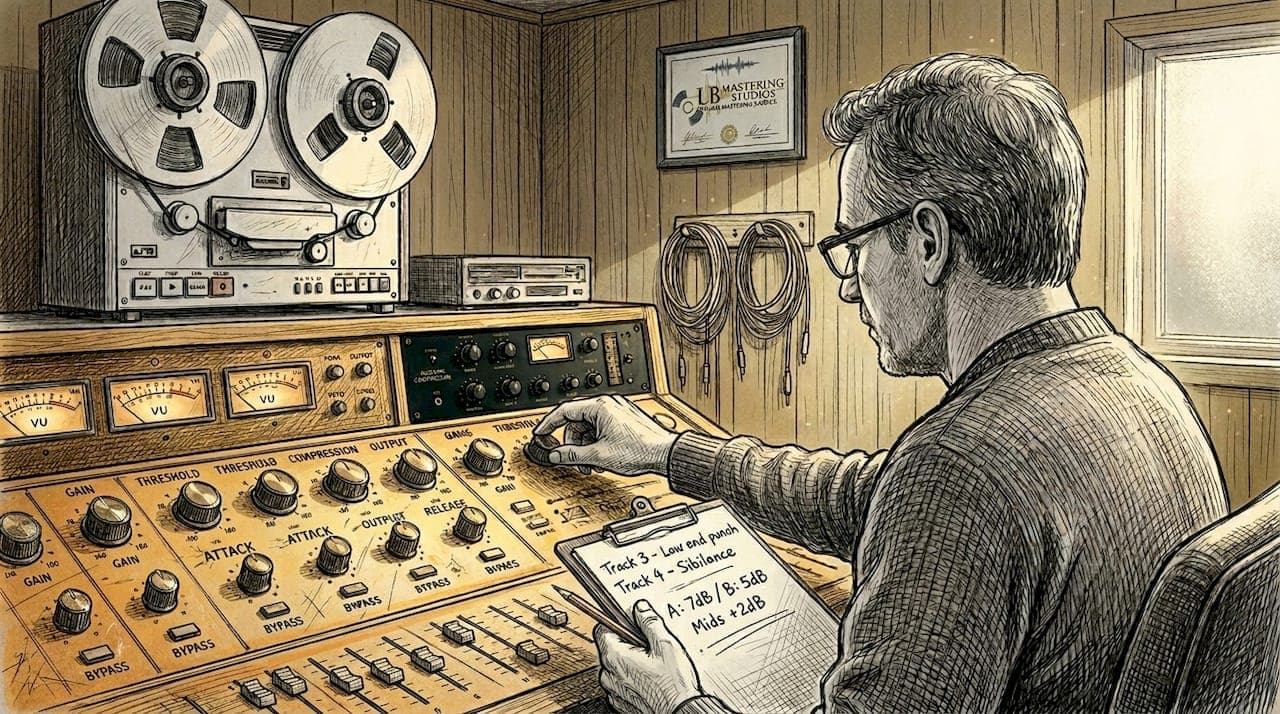
At the heart of every vintage piece of mastering equipment is a circuit design that was never intended to be "transparent." Tube amplifier stages, output transformers, and magnetic recording media all behave in ways that are technically imperfect but musically pleasing. These imperfections are not random noise. They are predictable, repeatable coloration that follows rules rooted in physics and electronics.
Understanding analog EQ's sonic traits helps clarify why these circuits behave so differently from their digital counterparts. When you push signal through a transformer, the core saturates gently and produces even-order harmonic distortion, which our ears perceive as fullness or "glue." Tubes behave similarly, adding second-harmonic content that sounds rich rather than harsh. Tape circuits contribute a gentle high-frequency roll-off and subtle compression at the peaks, which softens transients in a way that digital limiters often struggle to match without audible artifacts.
Here are the key characteristics that separate vintage mastering gear from purely modern options:
- Harmonic richness: Tube and transformer circuits add even-order harmonics that make individual tracks feel more cohesive within a full mix.
- Transient softening: Tape-style saturation gently rounds attack peaks, reducing listener fatigue without the pumping artifacts that aggressive digital limiting can introduce.
- Frequency-dependent compression: Many vintage compressors apply gain reduction that is inherently frequency-aware, which produces a natural-sounding glue rather than a blunt level reduction.
- Transformer coloration: Output and input transformers add a subtle but measurable low-mid density that engineers often describe as "weight" in the final master.
- Interactive controls: Vintage units frequently have fewer parameters that interact with each other in complex, musical ways rather than behaving as fully independent controls.
"The beauty of vintage analog circuits is that their imperfections are calibrated by decades of use in professional music production. What sounds like a flaw on paper often sounds like character on playback."
These qualities are especially evident when reviewing mastering gear essentials alongside modern alternatives. The coloration that vintage hardware provides is not always audible in isolation, but it becomes remarkably evident when you compare a master run through a fully analog chain against one processed entirely in the digital domain. The vintage master typically sounds more cohesive, with a three-dimensional quality that many listeners perceive immediately, even if they cannot articulate why.
Sound comparisons: Vintage vs. modern mastering tools
With that understanding of vintage coloration, let's look at how vintage gear truly compares to modern solutions, both in numbers and in real-world listening.
The most cited comparison point in this discussion involves the LA-2A optical compressor, a piece of gear that has been in professional studios since the 1960s. Research examining this specific unit found measurable differences between vintage and reissue versions of the LA-2A compressor, including variations in total harmonic distortion (THD), frequency response, and dynamic behavior. The study also found that whether trained listeners could consistently detect those differences depended heavily on the material being processed and the listening context.
This nuance matters. A vintage unit with higher THD does not automatically produce a better-sounding master. The coloration has to be appropriate for the music. For a dense rock or hip-hop record, the added harmonic weight of a vintage compressor can be exactly what elevates the master. For a sparse acoustic recording, the same coloration might cloud detail that should remain clean and open.
For a detailed discussion of analog warmth and how it translates to specific genres, context is everything. Here is a side-by-side summary of how the three main categories of mastering tools compare:
| Characteristic | Vintage hardware | Modern reissue | Digital plugin |
|---|---|---|---|
| Harmonic distortion | Higher, musically even-order | Moderate, manufacturer-controlled | Near zero or emulated |
| Frequency response | Gentle roll-off at extremes | Flatter, closer to spec | Precise, fully transparent |
| Transient behavior | Soft, natural saturation | Variable by model | Exact, algorithm-dependent |
| Recall precision | Low (must re-patch and re-trim) | Moderate | Perfect instant recall |
| Maintenance cost | High, ongoing | Low to moderate | Minimal |
| Workflow interaction | Tactile, limited controls | Mixed | Fully automated |
What this table makes clear is that no single category wins across every criterion. Vintage hardware scores highest for natural sonic coloration and tactile interaction but lowest for recall and maintenance cost. Digital tools score highest for precision, recall, and cost but deliver a fundamentally different coloration profile.
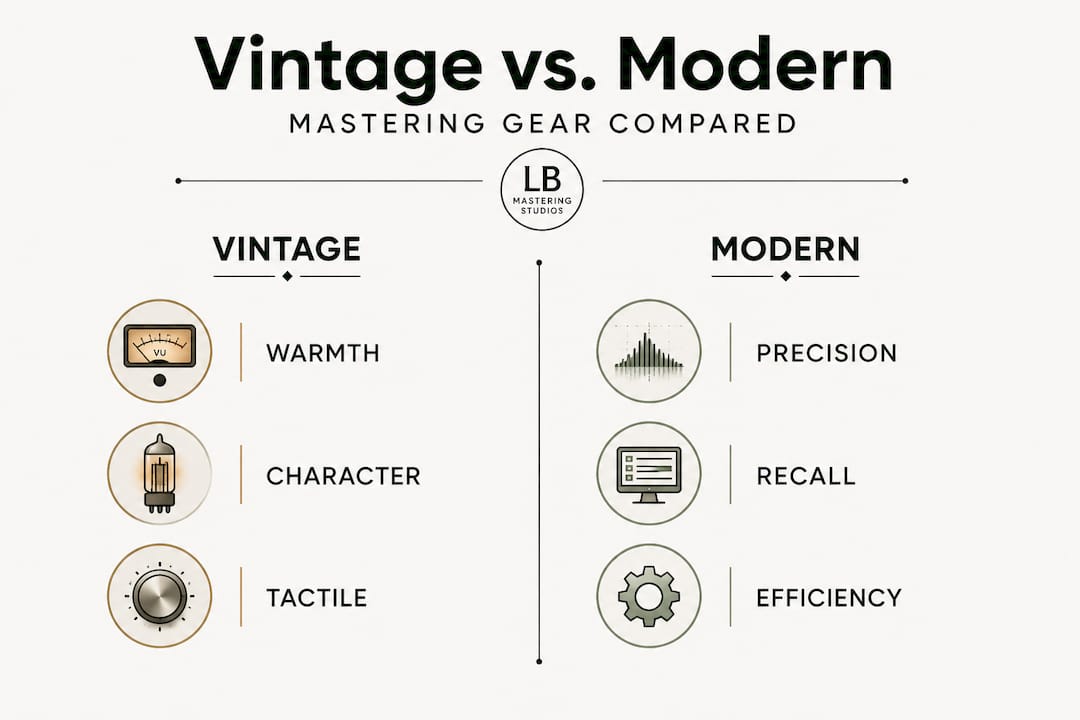
Looking at real-life mastering equipment examples in active studios confirms this picture. Many top-tier mastering engineers choose to use a hybrid approach precisely because they want the coloration of vintage hardware in the signal chain alongside the precision recall and measurement capabilities of modern digital tools. The combination captures the strengths of both worlds without forcing a compromise on either front.
Key takeaway: Measurable differences between vintage and modern gear are real, but their audibility depends on material, monitoring, and the skill of the engineer making the comparison.
Workflow advantages of using vintage gear
Beyond the direct sonic effects, vintage hardware reshapes the entire mastering process, fostering creativity in unique ways.
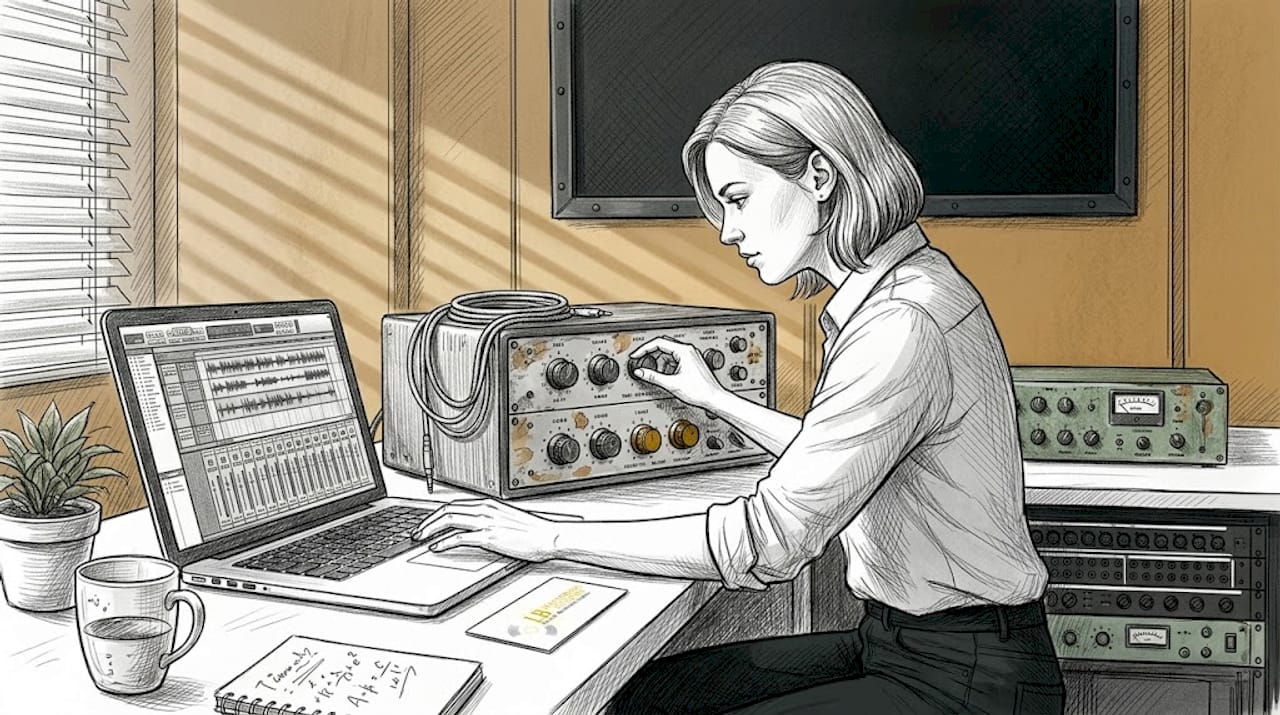
One of the most underappreciated advantages of vintage mastering gear is what it forces you not to do. Modern digital tools offer near-infinite parameter control, undo history, and instant recall. This abundance of options can actually slow creative decision-making and encourage endless second-guessing. Vintage hardware, by contrast, encourages faster commitment and more intentional mastering choices because the controls are fewer and the workflow demands decisiveness.
Here is how a typical mastering session changes when you route through vintage hardware:
- Signal routing and setup: You physically patch the unit into your signal chain, which creates a mental and tactile engagement that digital routing does not replicate. That physical act of patching is a deliberate creative commitment.
- Setting initial parameters: Vintage units typically offer between two and five main controls. You set them by ear, listening carefully to the material rather than referencing a screen or a preset menu.
- Committing to the sound: Because there is no undo button and recall is imprecise, you commit to your settings before moving on. This encourages a level of attentive listening that speeds up decision-making and builds genuine sonic confidence.
- Making comparative passes: You run the full track or a representative section through the unit at your chosen settings, comparing directly against the unprocessed signal to confirm the coloration is right for the project.
- Capturing the output: The processed signal is captured into your digital audio workstation (DAW) for further processing, measurement, and format-specific export.
Understanding how hybrid setups blend tactile and digital benefits is key to making this workflow practical in a professional context. The analog signal path delivers the coloration and the tactile engagement, while the digital side handles recall, metering, and multi-format delivery.
Pro Tip: If you want the creative benefits of vintage hardware without sacrificing revision speed, establish a standard gain-staging protocol for your vintage units and photograph every setting before you patch out. This gives you a reliable reference point for re-creating settings on revision requests, which is the most common operational challenge with vintage gear.
Practical considerations: Drawbacks and best use cases
Understanding the pros is important, but so too are the limitations and the realities of integrating vintage gear into your workflow.
It is worth stating directly: vintage gear is not always better. It comes with meaningful practical downsides that affect cost, turnaround time, and operational consistency. Many engineers, including those at the highest levels of the industry, argue that results depend more on the engineer's skill and taste than on whether the hardware carries a vintage badge.
Here is an honest look at where vintage gear helps and where it creates friction:
Situations where vintage gear adds clear value:
- Dense, complex mixes that benefit from natural glue and cohesion
- Vinyl mastering projects where the additional harmonic richness suits the medium
- Rock, soul, jazz, and hip-hop recordings where warmth and weight are stylistic goals
- Projects with generous timelines that allow deliberate, pass-based processing
Situations where digital tools are more practical:
- High-volume catalog work requiring fast turnaround and instant recall
- Projects with frequent client revision requests that need precise, repeatable adjustments
- Highly transparent genres such as classical or acoustic where coloration is unwanted
- Situations where budget constraints make maintenance cost prohibitive
| Factor | Vintage analog | Digital tools |
|---|---|---|
| Upfront cost | High (often $2,000 to $30,000+ per unit) | Low to moderate |
| Maintenance | Regular, ongoing, specialized | Minimal |
| Recall precision | Poor without detailed documentation | Perfect, session-based |
| Creative engagement | High, tactile, immediate | Variable |
| Revision speed | Slower, requires re-patching | Immediate |
| Sonic coloration | Natural, genre-appropriate | Transparent or emulated |
A practical mastering checklist for any project should include an honest assessment of which workflow fits the client's timeline and creative goals. Not every project needs a vintage analog chain, and forcing vintage coloration onto material that does not benefit from it is a creative misstep regardless of the hardware's pedigree.
The smartest approach is to treat vintage gear as a specialized tool, one you reach for deliberately when the material and the goal align with its strengths, rather than as a default signal path for every project.
Why gear isn't the whole story: The overlooked factor in mastering results
Over 44 years of professional mastering experience teaches you something that no equipment catalog ever will: the hardware does not make the master. The engineer does.
This is not false modesty. It is a practical truth that shapes every session we run at LB-Mastering Studios. We have heard masters processed through the finest vintage hardware sound flat and lifeless because the listening environment was compromised or because the decisions made at the console were uninformed. We have also heard stunning masters produced on entirely digital chains by engineers with exceptional ears and a deep understanding of the music they were serving. Results depend more on skill than on hardware, particularly in complex, dense mixes where individual gear contributions can become nearly inaudible.
What actually shapes a great master is a combination of three things: accurate monitoring, musical taste, and a clear understanding of where the track needs to go. Vintage gear can contribute meaningfully to that process, but it cannot compensate for an untreated room, an engineer without critical listening skills, or a master that was assembled without a clear sonic vision.
Understanding how mastering expertise shapes results makes it clear that the best use of vintage hardware is as an expressive tool in the hands of someone who genuinely knows how it behaves and why. We use vintage gear because we know precisely what it will do to a given piece of audio, not because it carries a vintage label.
The "ears over gear" principle is not an argument against vintage hardware. It is an argument for context. Use vintage gear when it serves the music. Use digital tools when they serve the workflow. Let the combination of skill, monitoring, and intentional decision-making drive the result, because that combination will outlast any piece of hardware on your rack.
Ready to elevate your sound? Explore vintage and hybrid mastering options
If the qualities described in this article match what you have been searching for in your own masters, we would love to show you what a professional hybrid signal chain can do for your music. At LB-Mastering Studios, our studio is built around a carefully selected collection of vintage mastering equipment, integrated with modern digital precision to deliver the warmth and clarity your recordings deserve.
Whether you are preparing a release for streaming, CD, or vinyl mastering, our team brings over 44 years of Grammy-winning experience directly to your project. Every session includes direct communication with your mastering engineer, a free sample master so you can hear the results before committing, and the confidence that comes from working with one of the most experienced studios in North Carolina. Download our free audio mastering checklist to prepare your tracks for the best possible outcome, and reach out to discuss how we can bring your next project to life.
Frequently asked questions
Can you replicate vintage gear sound with plugins?
Many plugins emulate vintage coloration effectively for convenience, but the subtle non-linearity and tactile workflow advantages of actual hardware can still differ in ways that analog gear's practical limits make relevant depending on the project.
Do trained listeners always hear the difference?
Not always. Research shows that audible differences between vintage and reissue gear are measurable but context-dependent, and detection reliability varies significantly based on the source material and listening environment.
Is analog mastering gear always better than digital?
No. Many engineers favor digital workflow flexibility or cost advantages, and modern digital tools can deliver excellent results, especially for genres where transparent processing is the goal.
What are the main drawbacks of using vintage gear?
Vintage hardware typically introduces higher purchase cost, ongoing maintenance requirements, and slower revision turnaround because recall limitations make it difficult to precisely re-create settings after a session ends.