
TL;DR:
- Analog EQ introduces harmonic distortion that adds warmth, depth, and musical character to recordings.
- It is especially beneficial for genres like rock, jazz, and acoustic music where organic textures matter.
- Combining analog and digital EQ provides a flexible, efficient approach, balancing vibe with precision.
Digital audio workstations and precision plugins now dominate most studios, yet a surprising number of top mastering engineers still route their signal through vintage hardware before it ever reaches a streaming platform. The reason is not nostalgia. Analog EQ introduces subtle harmonic textures that shape how listeners feel a recording, not just how they hear it. If you are an independent musician or a label A&R looking to give your releases a richer, more three-dimensional sound, understanding analog EQ is genuinely useful knowledge. This guide covers the science, the real-world applications, and the honest trade-offs so you can make smarter decisions about your mastering chain.
Table of Contents
- The science behind analog EQ and warmth
- Analog EQ in music production: Where it excels
- Analog vs digital EQ: Myths, facts, and practical realities
- Is analog EQ right for your project?
- Our take: What most guides miss about analog EQ
- Hear the warmth: Analog EQ mastering at LB-Mastering
- Frequently asked questions
Key Takeaways
| Point | Details |
|---|---|
| Analog EQ adds warmth | Analog EQ imparts subtle harmonic distortion and coloration that many digital EQs can only approximate. |
| Hybrid mastering approach | Combining analog for character with digital EQ for surgical precision offers the best results for most genres. |
| Context matters | Analog EQ shines in genres like rock and jazz, while digital EQ is ideal for pinpoint adjustments and transparency. |
| No universal superiority | Blind tests show no definitive winner; choose based on your project’s aesthetic goals and workflow. |
The science behind analog EQ and warmth
Before we decide if analog EQ is right for your music, let's uncover what makes its sound special.
Analog EQ works through physical electronic components: tubes, transformers, capacitors, and resistors. These components do not process audio with perfect mathematical accuracy. They bend, color, and gently saturate the signal as it passes through. That imperfection is the entire point.
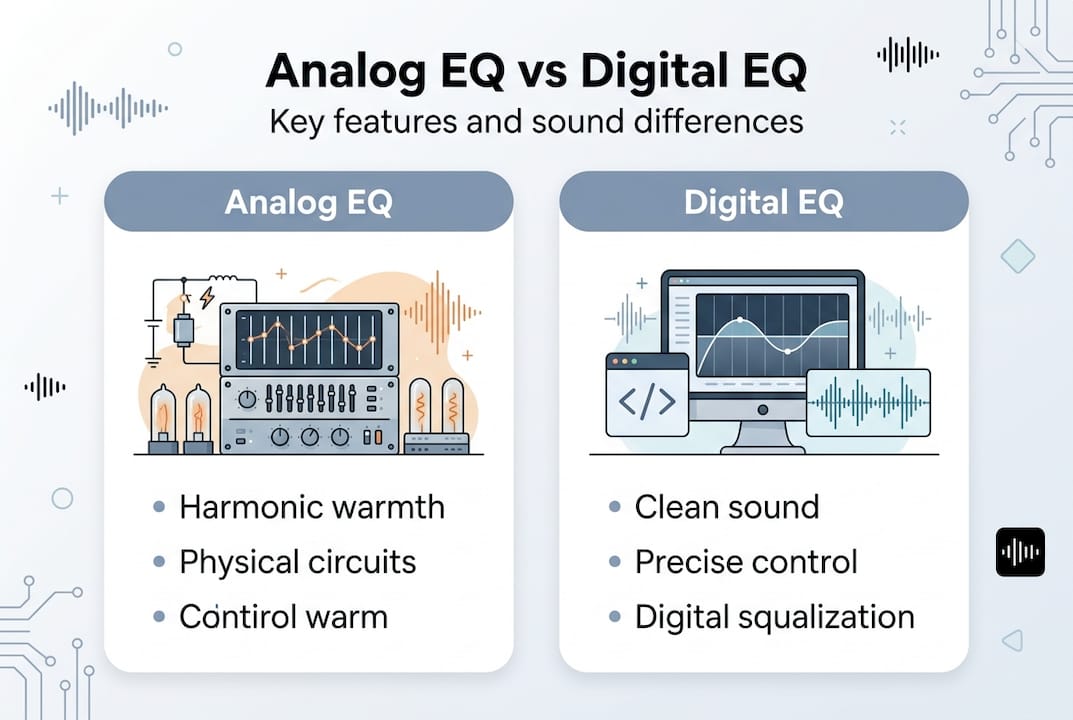
The key concept here is harmonic distortion. When audio passes through a tube circuit, it generates even-order harmonics, which are frequency multiples that sit in musically consonant relationships to the original signal. Your ear interprets these as warmth, body, and depth. Transformers, on the other hand, tend to produce odd-order harmonics, which add a subtle edge or bite to transients. Together, these interactions create what engineers call analog color.
Digital EQ applies mathematical algorithms to reshape frequency curves with near-perfect precision. There is nothing wrong with that. But the process is linear, meaning it does not add or subtract harmonic content the way physical components do. The result is clean and accurate, but it can also feel sterile on certain source material.
"Analog EQ imparts warmth through even-order harmonics from tubes and odd-order from transformers, creating subtle saturation and depth not perfectly replicated by digital EQ."
Here is a quick comparison of the two signal types:
| Feature | Analog EQ | Digital EQ |
|---|---|---|
| Harmonic content | Adds even/odd-order harmonics | No harmonic addition |
| Precision | Moderate, component-dependent | Extremely precise |
| Workflow | Tactile, hands-on | Recall-friendly, automatable |
| Cost | Higher upfront | Lower, software-based |
| Coloration | Inherent character | Transparent by default |
The subtle non-linearities in analog circuitry are genuinely difficult to replicate in software. Plugin developers have made impressive progress with convolution modeling and circuit simulation, but the randomness of real components, including thermal drift and component aging, produces micro-variations that no algorithm has fully captured yet. That is not a knock on digital tools. It simply means each approach has a distinct character, and knowing which one serves your project is what separates good mastering from great mastering.
Analog EQ in music production: Where it excels
Armed with technical insight, let's see how these qualities translate in real-life audio work.
Analog EQ earns its place most clearly in genres where organic texture matters. Rock, jazz, blues, country, and acoustic music all benefit from the gentle saturation analog gear introduces. The natural saturation and tactile workflow that analog provides fosters creative decisions that are preferred in these styles, where warmth is not just aesthetic but essential to the genre's identity.
Here are the most common production scenarios where analog EQ delivers a tangible advantage:
- Adding depth to a flat mix: Routing a sterile-sounding master bus through a tube-based EQ can add three-dimensionality without any obvious boost or cut.
- Gluing mix elements together: Analog saturation creates subtle harmonic relationships between instruments, making them feel like they belong in the same room.
- Smoothing low-end frequencies: Analog filters roll off sub-bass in a gradual, musical way rather than the sharp, sometimes clinical cuts digital EQ can produce.
- Enhancing acoustic instruments: Guitars, upright bass, and piano respond especially well to the mid-range coloration that vintage EQ hardware provides.
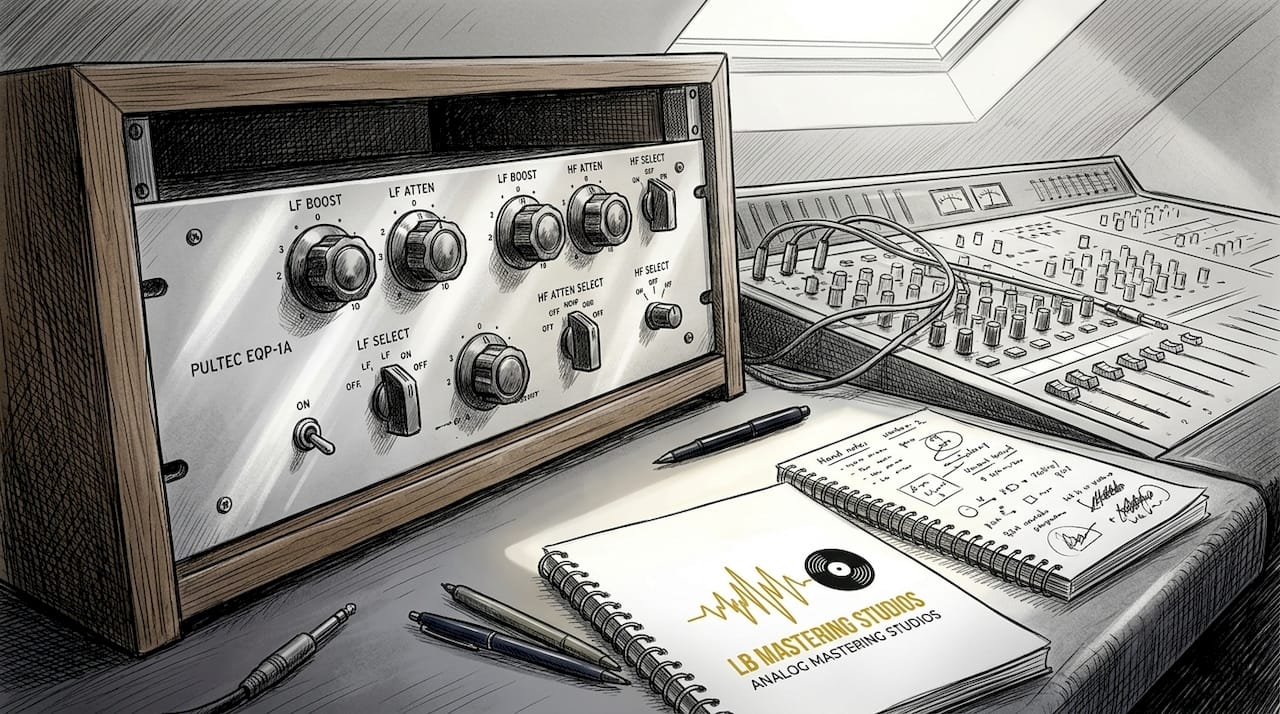
Specific hardware has become legendary for exactly these qualities. The Pultec EQP-1A is perhaps the most celebrated example. Its passive filter design followed by tube makeup gain allows a simultaneous boost and cut on the same frequency. For instance, boosting and cutting at 60Hz simultaneously creates a punchy, tight low-end that is nearly impossible to replicate with a standard digital parametric EQ. The Neve 1073 and SSL G-Series channel EQs are equally revered for their ability to add presence and air without harshness.
For labels considering analog vs digital mastering equipment, the choice often comes down to the format and the genre. Analog EQ is also a natural fit for analog EQ in vinyl mastering, where the signal chain benefits from hardware that shares the same electrical heritage as the format itself.
Pro Tip: Place analog EQ early in your mastering chain to establish the overall character of the recording. Then use digital EQ later in the chain for any precise surgical corrections, such as removing a narrow resonance or taming a harsh frequency spike.
Analog vs digital EQ: Myths, facts, and practical realities
Now that we know where analog shines, it's time to examine how it stacks up against digital EQ in real-world usage.
The most persistent myth in audio production is that analog automatically sounds better. It does not, at least not in any measurable, universal way.
show analog EQ to be empirically superior. The differences are often subtle, and listener preference plays a significant role in how those differences are perceived.Here are the most common myths and the honest realities behind them:
- Myth: Analog always sounds warmer. Reality: Analog adds harmonic content, which can sound warm or harsh depending on the circuit and how hard it is driven.
- Myth: Digital EQ is lifeless. Reality: Digital EQ is transparent, which is exactly what you want for precise corrective work or genres that prioritize clarity.
- Myth: Plugins cannot sound like hardware. Reality: Modern emulations are remarkably close, though warmth is perceptual and not a measurable superiority of one format over another.
- Myth: Analog gear is always worth the cost. Reality: For many modern pop, electronic, and hip-hop productions, a transparent digital EQ is the better tool.
- Myth: You need hardware to achieve professional results. Reality: Countless chart-topping records have been mastered entirely in the box with outstanding results.
The practical advantage of digital EQ is undeniable in certain areas. Total recall means you can reopen a session months later and reproduce exact settings. Ultra-fine adjustments of 0.1 dB are routine. And the cost of entry is a fraction of what quality hardware demands.
Where analog wins is in workflow inspiration and clarity in mastering through character. Many engineers report making bolder, more musical decisions when working with hardware because the tactile interaction changes how they listen. That creative shift is real and worth considering when you plan your sessions. For a deeper look at the full mastering process, a professional mastering guide can help you see where each tool fits.
Pro Tip: Combine analog and digital EQ in a hybrid chain. Use analog for broad tonal shaping and character, then switch to digital for any narrow-band corrections. This approach gives you the best results from both worlds without compromise.
Is analog EQ right for your project?
With a balanced view of the analog-versus-digital debate, let's turn to how you can make the right decision for your own music.
The answer depends on three factors: your genre, your budget, and your sonic goals. Here is a straightforward breakdown:
- Rock, jazz, blues, acoustic, and country: Analog EQ is a strong fit. The harmonic coloration aligns with the sonic expectations of these genres.
- Electronic, pop, and hip-hop: Digital EQ is often the better choice. Transparency and precision serve these styles more than added color.
- Vinyl releases: Analog EQ is especially well-suited. The signal chain compatibility between analog hardware and the vinyl format makes it a natural pairing, and it is less ideal for precision electronic or pop work where digital transparency is key.
- Limited budget: Start with quality digital EQ and invest in hardware as your project scale grows. Hybrid approaches balance cost and quality effectively.
- Hybrid strategy: Hybrid analog-digital mastering lets you apply analog EQ for warmth on buses and masters while digital handles surgical tasks, giving independent musicians and labels an efficient path to professional results.
For vinyl projects specifically, the vinyl mastering guide at LB-Mastering walks through the exact considerations that make analog gear so valuable in that format. And if you want to understand the full hardware picture, our mastering equipment overview covers the tools we use and why.
The most important step is to assess your project goals before committing to a signal chain. Ask yourself what the finished record needs to feel like, which format it will live on, and what your listeners expect from the genre. Those answers will point you toward the right tools every time.
Pro Tip: Analog EQ adds the most value during mastering when the mix already sounds good. It is not a fix for a broken mix. Use it to enhance what is already working, and rely on digital EQ for anything that needs corrective attention.
Our take: What most guides miss about analog EQ
Most articles about analog EQ fall into one of two traps. They either romanticize it as some kind of sonic magic that digital can never touch, or they dismiss it entirely as expensive nostalgia. After decades of mastering sessions at LB-Mastering Studios, we find both positions frustrating because neither serves the musician.
The honest truth is that analog EQ is a tool, a very good one in the right context, but still a tool. Its value is in the subtle enhancements it makes to harmonic content and in the way it changes how an engineer interacts with the material. That workflow shift is real. When you are turning a physical knob and listening for the circuit to breathe, you make different decisions than when you are clicking a mouse.
The studios and artists who get the most out of balancing analog and digital are the ones who treat each tool as purposeful. Analog for vibe and character. Digital for control and precision. Knowing when to use which one is where genuine mastering expertise lives. That is the skill most guides skip over entirely.
Hear the warmth: Analog EQ mastering at LB-Mastering
Ready to experience true analog warmth in your own productions?
At LB-Mastering Studios, we have spent over 44 years building a hybrid signal chain that puts both analog and digital tools to work for every project we touch. Whether your record calls for the rich coloration of vintage hardware or the surgical precision of modern digital processing, we have the experience and the analog and digital equipment to deliver exceptional sonic results.
From vinyl mastering services to streaming-ready stereo masters, we tailor every session to your music and your goals. You can also download our audio mastering checklist to prepare your files before your first session. Reach out today and let's talk about what your music needs.
Frequently asked questions
Does analog EQ really sound better than digital EQ?
No definitive blind tests confirm analog EQ is universally superior. Analog adds subtle warmth through harmonic content, but the preference and context of the project are what ultimately determine which tool sounds better.
Which music genres benefit most from analog EQ?
Rock, jazz, and acoustic styles gain the most from analog EQ's natural warmth and gentle saturation. The tactile workflow and natural saturation analog provides align closely with the sonic character these genres demand.
Can digital EQ plugins replicate analog warmth?
Modern plugins come close, but true analog gear generates nuanced harmonic interactions that software only approximates. The even and odd-order harmonics produced by real tubes and transformers remain difficult to fully model in code.
When should I choose analog EQ over digital?
Choose analog when you want warmth, depth, and a tactile creative workflow, particularly for vinyl or organic genre recordings. Analog EQ excels in vinyl mastering due to signal chain compatibility, while digital remains the stronger choice for precision electronic and pop work.
Is analog EQ worth the investment for indie producers?
If warmth and classic coloration are central to your sound, analog EQ can be a worthwhile investment. For most indie producers, a hybrid analog-digital approach that uses analog for character and digital for surgical control offers the best balance of quality and cost.