

TL;DR:
- Metering in audio mastering involves using visual tools to measure loudness, peaks, and dynamics objectively, preventing ear fatigue from misleading perceptions.
- Understanding sample peak, true peak, and LUFS meters ensures masters maintain sonic integrity across formats and streaming platforms, each answering different measurement questions.
Maximizing your meters does not mean maximizing your master. That's a hard truth many independent musicians and entry-level engineers only discover after their tracks sound thin, distorted, or inconsistent across streaming platforms. Metering in audio mastering is one of the most technically rich and frequently misunderstood areas of the entire production process. Getting it right means knowing what each meter actually measures, which industry standards matter, and how to translate those numbers into decisions that protect your music's sonic integrity. This guide breaks all of that down clearly, so your masters translate everywhere they play.
Table of Contents
- What is metering in audio mastering?
- Key metering types: Sample Peak, True Peak, and LUFS
- Industry standards: EBU R128, ITU-R BS.1770, and mastering targets
- How to use metering for better masters: Workflow and best practices
- Myths, limitations, and what many miss about metering
- Why mastering metering matters more—and less—than you think
- Level up your mastering with expert metering support
- Frequently asked questions
Key Takeaways
| Point | Details |
|---|---|
| Use LUFS for loudness | LUFS metering provides a consistent and platform-accepted measure for targeting average loudness in mastering. |
| Always check True Peak | True Peak meters help prevent unwanted digital distortion and comply with streaming and broadcast requirements. |
| Meter after limiting | Final loudness and peak measurements must be taken after limiting to reflect the true, delivered audio output. |
| Standards guide, not dictate | Metering standards are useful frameworks, but creative and musical decisions must always lead the mastering process. |
| Handle edge cases | Quiet sections and inter-sample peaks require special attention to ensure professional-sounding, compliant masters. |
What is metering in audio mastering?
Metering means using visual and numerical tools to objectively measure your audio's loudness, peaks, and dynamic behavior throughout the mastering process. Without meters, your ears alone can mislead you, especially after long sessions when ear fatigue sets in. Meters give you an objective reference point that doesn't get tired.
In mastering specifically, three core meter types drive nearly every technical decision:
- Sample peak meters: Show the maximum digital value at any given sample point in the signal.
- True peak meters: Estimate the actual maximum level after digital-to-analog conversion, catching peaks that sample peak meters miss.
- LUFS meters: Measure loudness in Loudness Units relative to Full Scale, reflecting the perceived loudness of your audio over time.
Each of these answers a different question about your master. Sample peak tells you where your digital ceiling sits. True peak tells you what happens when that signal leaves the digital domain. LUFS tells you how loud your music actually feels to a listener, not just what the waveform looks like on screen.
Optimal loudness in mastering is not about cramming every signal to 0 dBFS. It's about balancing these three measurement types intelligently. As the mastering checklist for engineers reinforces, understanding what each meter does before you touch a compressor or limiter is essential preparation.
The modern standard for loudness measurement is LUFS, specifically integrated LUFS measured using the ITU-R BS.1770 loudness model with a K-weighting filter and time aggregation, plus gating (in EBU R128) to ignore very quiet sections. This approach produces a loudness value that reflects how humans actually perceive audio, not just raw amplitude.
Quick reference: Think of sample peak as the height of a wave on paper, True Peak as how high that wave actually crashes on shore, and LUFS as the average energy of the ocean during a storm. All three tell you something different, and all three matter.
Key metering types: Sample Peak, True Peak, and LUFS
Understanding the difference between these three meter types is fundamental to producing masters that survive the journey from your workstation to a listener's earbuds.
Sample peak is the oldest and simplest measurement. It reads the loudest sample in your digital audio file. The problem is that digital audio is a series of discrete snapshots. The real audio wave between those snapshots can exceed the value your sample peak meter shows. That gap between measured and actual amplitude is where trouble lives.
True peak addresses exactly that problem. True Peak metering estimates inter-sample peaks that can occur after digital-to-analog reconstruction and during lossy codec decoding. When your file gets converted to MP3 or AAC for streaming, those inter-sample peaks can push the signal past the ceiling, causing audible clipping that your sample peak meter never warned you about. True Peak meters oversample the signal to predict where those hidden peaks will land.
LUFS (Loudness Units Full Scale) provides a standardized loudness average that is far more useful than RMS or peak readings for streaming, broadcast, and cross-platform consistency. Integrated LUFS captures the average loudness across an entire program. Short-term LUFS shows loudness over a rolling three-second window. Momentary LUFS gives you a 400-millisecond snapshot. Each of these has its place in a mastering session.
| Meter type | What it measures | Best use case | Limitation |
|---|---|---|---|
| Sample peak | Highest digital sample value | Quick clip check | Misses inter-sample overs |
| True Peak | Estimated post-DA maximum | Codec and broadcast safety | Adds processing overhead |
| Integrated LUFS | Average program loudness | Streaming target compliance | Influenced by silence and dynamics |
| Short-term LUFS | Loudness over 3 seconds | Identifying loud sections | Less granular than momentary |
| Momentary LUFS | Loudness over 400ms | Real-time monitoring | Too fast for full-song decisions |
Pro Tip: Always set your True Peak limiter ceiling to at least -1 dBTP before delivering a master. This gives codecs and DA converters room to breathe without introducing distortion your listeners will hear immediately.
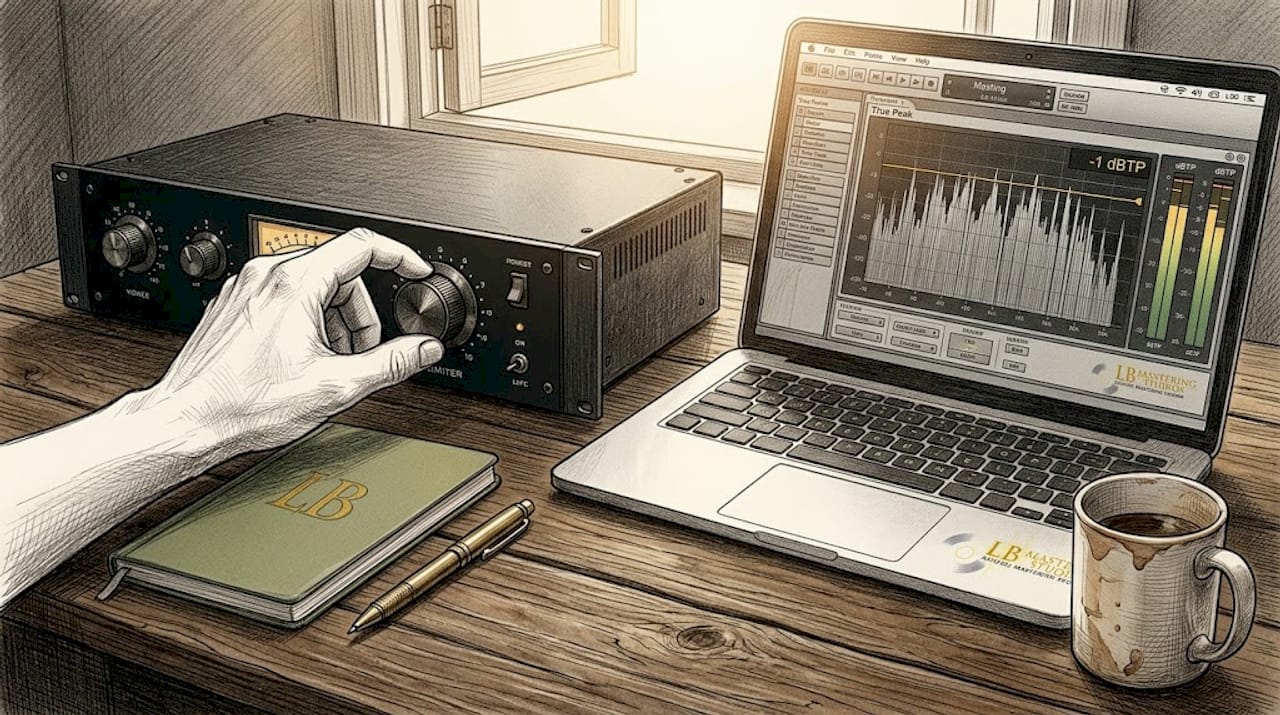
For clarity in mastering, using True Peak as your safety net and integrated LUFS as your delivery target is the professional workflow standard. These two meters work together. When you master your tracks for streaming, vinyl, and CD, the specific target values change by format, but the metering methodology stays consistent.
Industry standards: EBU R128, ITU-R BS.1770, and mastering targets
With the right meters in place, the next step is knowing what numbers to aim for. That's where global industry standards come in.
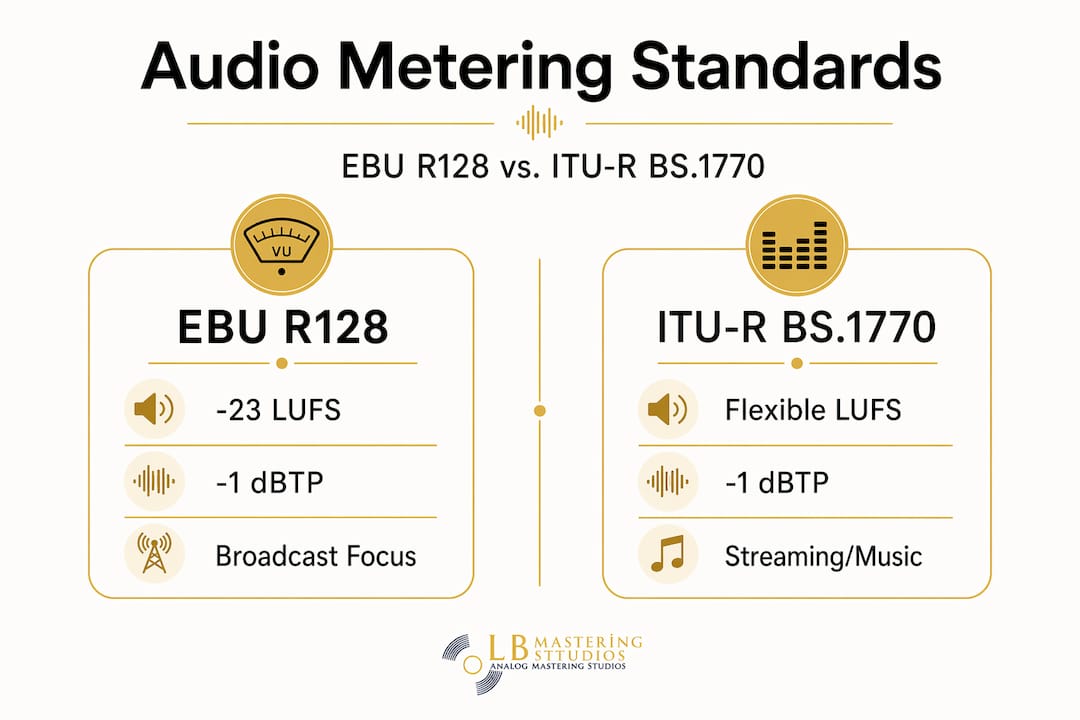
EBU R128 specifies a target integrated loudness around -23 LUFS with a tolerance, and constrains maximum true peak to -1 dBTP. It uses loudness gating to exclude very quiet passages so that silence between tracks doesn't pull your integrated reading down artificially. ITU-R BS.1770 is the underlying loudness model that powers EBU R128, using K-weighting (a specific frequency weighting designed to match human hearing sensitivity) and time-domain averaging.
These standards were designed primarily for broadcast television and radio. Streaming platforms adapted them for music delivery but with different integrated loudness targets, which is why mastering for Spotify feels different from mastering for broadcast.
Here's a quick look at current platform targets:
| Platform | Integrated loudness target | True Peak limit |
|---|---|---|
| Spotify | -14 LUFS (normalization point) | -1 dBTP |
| Apple Music | -16 LUFS (normalization point) | -1 dBTP |
| YouTube | -14 LUFS (normalization point) | -1 dBTP |
| Amazon Music HD | -14 LUFS (normalization point) | -1 dBTP |
| EBU R128 (broadcast) | -23 LUFS | -1 dBTP |
| CD (no normalization) | Variable (often -9 to -12 LUFS) | 0 dBFS (sample) |
A few critical things to understand about these targets:
- Normalization works both ways. If your master is louder than a platform's target, they will turn it down. If it's quieter, some platforms will turn it up, which can expose noise or reduce headroom you carefully preserved.
- Louder masters lose dynamics. Heavily limited tracks may measure loud, but after normalization, a more dynamic master will often sound better because it hasn't been crushed to hit a number.
- True Peak limits apply regardless of normalization. Even if a platform turns your track down, distortion already baked in from inter-sample peaks doesn't go away.
- CD has no loudness normalization. This means the loudness wars still exist in the physical format space, which is a genuine creative and technical trade-off engineers must weigh.
To maximize loudness for music playback responsibly, you need to know not just where your integrated LUFS lands, but whether your master holds up dynamically after normalization. For a broader view of how these principles apply across formats, the mastering tips and industry blog covers platform-specific guidance regularly.
Statistic to know: A master delivered at -8 LUFS integrated will be turned down by approximately 6 dB on Spotify compared to one delivered at -14 LUFS. That's 6 dB of dynamic range you sacrificed during limiting, now completely wasted.
How to use metering for better masters: Workflow and best practices
Knowing what meters do and what the targets are is only half the job. Applying them correctly in your session is where professional results actually happen.
Your loudness and True Peak meters should always be placed post-limiter in your signal chain. Placing meters after limiting ensures you measure the actual delivered master level, not the pre-limiter signal. Measuring before your limiter gives you false readings that won't reflect what your listener hears or what a streaming platform receives.
A practical metering workflow in mastering looks like this:
- Step 1: Set your LUFS target based on your delivery format (streaming, CD, broadcast).
- Step 2: Apply your analog or digital processing chain, then place a True Peak limiter as your final stage with a ceiling of -1 dBTP.
- Step 3: Run your integrated LUFS measurement on the full master. Check that it lands within your target range.
- Step 4: Review your momentary and short-term LUFS readings to identify whether loud sections are contributing most of your integrated loudness or whether quiet sections are skewing the reading.
- Step 5: Confirm True Peak is within limits. Look specifically at transient-heavy sections (drum hits, plucked strings, vocal sibilance) where inter-sample peaks are most likely to appear.
Gating in LUFS meters is a critical feature that many engineers overlook. When gating is active, the meter ignores audio below a certain threshold, typically -70 LUFS momentary, so that silence between tracks doesn't drag your integrated reading down. Without gating, a track with several seconds of silence before the outro would read quieter than it actually sounds.
Pro Tip: When reviewing your integrated LUFS reading, cross-check it against your short-term maximum. If your short-term peaks are much louder than your integrated reading, you likely have a highly dynamic track that will sound excellent after normalization. Embrace that, don't fight it with more limiting.
For reference, the sample mastering explained guide shows how this workflow applies to real tracks, and the mastering checklist for artists is an excellent companion resource for preparing your files before a session.
Myths, limitations, and what many miss about metering
Metering is powerful, but it is not perfect. Understanding the genuine limitations of current metering systems keeps you from making decisions that serve the numbers rather than the music.
Some engineers argue that broadcast-style loudness metering can be confusing or may not perfectly match music perception beyond being a proxy measurement. That debate is legitimate and worth taking seriously.
"LUFS is a proxy measurement. It correlates with perceived loudness better than peak or RMS, but it does not capture the full picture of how a human being experiences musical loudness."
Here are the most common limitations mastering engineers encounter:
- Frequency content distorts perceived loudness. A bass-heavy track can read -14 LUFS but feel much louder than a treble-heavy track at the same LUFS value, because low frequencies carry more energy at lower perceived volume.
- Dynamics confuse integrated readings. A classical recording with large dynamic swings may read -23 LUFS integrated but have sections that feel as loud as a pop track at -10 LUFS. The number doesn't capture that experience.
- Silence skews results even with gating. Extended quiet intros, ambient passages, and fadeouts all affect your integrated reading. Gating helps, but it is not a complete solution for every track structure.
- Inter-sample peaks are genuinely unpredictable. True Peak meters estimate where peaks will land post-conversion, but specific codec implementations can still behave differently in ways your meter won't predict with perfect accuracy.
The takeaway is not that meters are unreliable. It's that they are tools, and like all tools, their value depends on the skill and judgment of the person using them. Chasing a number without listening to the result is a recipe for technically compliant but emotionally flat masters. Revisiting the concept of optimal loudness in mastering with these limitations in mind helps frame metering as one part of a larger creative and technical process.
Why mastering metering matters more—and less—than you think
Here's our honest, experience-based perspective after more than 44 years in professional mastering: meters matter enormously, and they also matter far less than the music industry has trained people to believe.
Meters give you accountability. They create reproducibility across sessions and engineers. They ensure your master translates accurately from studio monitors to laptop speakers, from a vinyl pressing plant to a streaming platform's delivery spec. Without reliable metering, professional mastering simply cannot exist. There is no arguing with that.
But we see artists and engineers every week who have become so focused on hitting -14 LUFS that they have forgotten to ask whether the track sounds right. They run the limiter hard, check the number, and send the file, never noticing that they've squeezed the life out of a beautiful performance. The meter said "pass." The music said otherwise.
The standard is a tool, not a verdict. A track that measures -16 LUFS but moves people is worth more than a track that measures -14 LUFS but feels flat. Our recommendation is to use meters to catch what your ears genuinely cannot, including True Peak overs that only exist post-codec and integrated loudness values that might surprise you over a full album. But always let clarity in mastering and emotional impact guide your final decisions, not a number on a screen.
Meters provide a floor. Great mastering builds above it.
Level up your mastering with expert metering support
Understanding metering theory is a meaningful step forward. Applying it correctly across every format, platform, and genre is where professional mastering engineers earn their place in the process.
At LB-Mastering Studios, our engineers deploy best-in-class True Peak, LUFS, and dynamic metering tools throughout every session to guarantee that your master meets both technical standards and creative goals. With Grammy-winning expertise and over 44 years of experience, we know exactly how to balance the numbers with the music. Download our free mastering checklist to prepare your files correctly before any session. When you're ready for professional results, explore our CD mastering services and vinyl mastering services for format-specific excellence from engineers who get it right every time.
Frequently asked questions
What are the best LUFS and True Peak levels for Spotify, Apple Music, and CD?
Aim for -14 LUFS integrated and a maximum True Peak of -1 dBTP for streaming platforms. For CD, a slightly higher loudness is acceptable, but EBU R128 specifies -1 dBTP as the universal True Peak ceiling regardless of format.
Why is post-limiter metering important in mastering?
Post-limiter metering ensures you measure the actual delivered signal that reaches the listener. Metering decisions in mastering are operationally post-processor, meaning any measurement taken before your limiter will not reflect the true delivered level.
How do inter-sample peaks affect my master?
Inter-sample peaks cause audible distortion during playback and codec conversion even when your sample peak meter reads safely below 0 dBFS. True Peak meters estimate these inter-sample peaks after digital-to-analog reconstruction, making them essential for catching hidden distortion before delivery.
Does integrated LUFS always reflect what listeners perceive as loud?
Not always. There are contrasting viewpoints on how accurately broadcast-style loudness metering represents musical loudness, since frequency content, dynamics, and human perception all interact in ways a single integrated number cannot fully capture.