

TL;DR:
- Audio finishing ensures project readiness through quality control, proper metadata, and format-specific processing.
- Vinyl and digital formats require different technical preparations to prevent rejection and sound issues.
- Proper finishing protects against surprises, ensures consistency across formats, and respects listener experience.
Mastering your tracks is a milestone worth celebrating, but it does not automatically mean your project is ready to ship. Many independent musicians and record labels submit their mastered files to a distributor or vinyl pressing plant only to discover that something critical was missed: a rogue click buried in the low mids, missing metadata, or a master that is simply too hot for the cutting lathe. Audio finishing is the professional discipline that closes the gap between a polished master and a truly release-ready recording. This guide will show you exactly what finishing involves, why it is essential, and how to execute it correctly for both digital and vinyl formats.
Table of Contents
- What is audio finishing in music production?
- Key elements of audio finishing
- Why finishing differs for vinyl vs. digital
- How to ensure your audio is truly release-ready
- The real reason audio finishing matters: beyond the technical details
- Get expert audio finishing for your next release
- Frequently asked questions
Key Takeaways
| Point | Details |
|---|---|
| Finishing is essential | Audio finishing ensures your mastered tracks meet the right specs for vinyl, digital, or CD release. |
| Format matters | Vinyl and digital require separate finishing steps for best results due to unique format constraints. |
| Quality control is critical | Final technical and creative checks prevent unwanted surprises and costly revisions. |
| Custom masters required | Don’t use one master for all platforms—create and finish tracks for each format's needs. |
What is audio finishing in music production?
Now that we've set the stage, let's define what audio finishing actually involves and why it matters.
Most people think of the production chain as recording, mixing, then mastering. That is largely accurate, but it leaves out a critical final layer. Audio finishing means the last post-production steps that prepare a track for release, including cleanup and quality control, plus final processing so the delivered audio meets platform or physical format requirements. It is not a synonym for mastering. It is what happens after mastering, or sometimes runs parallel to it, to ensure that every deliverable is technically correct and format-appropriate.
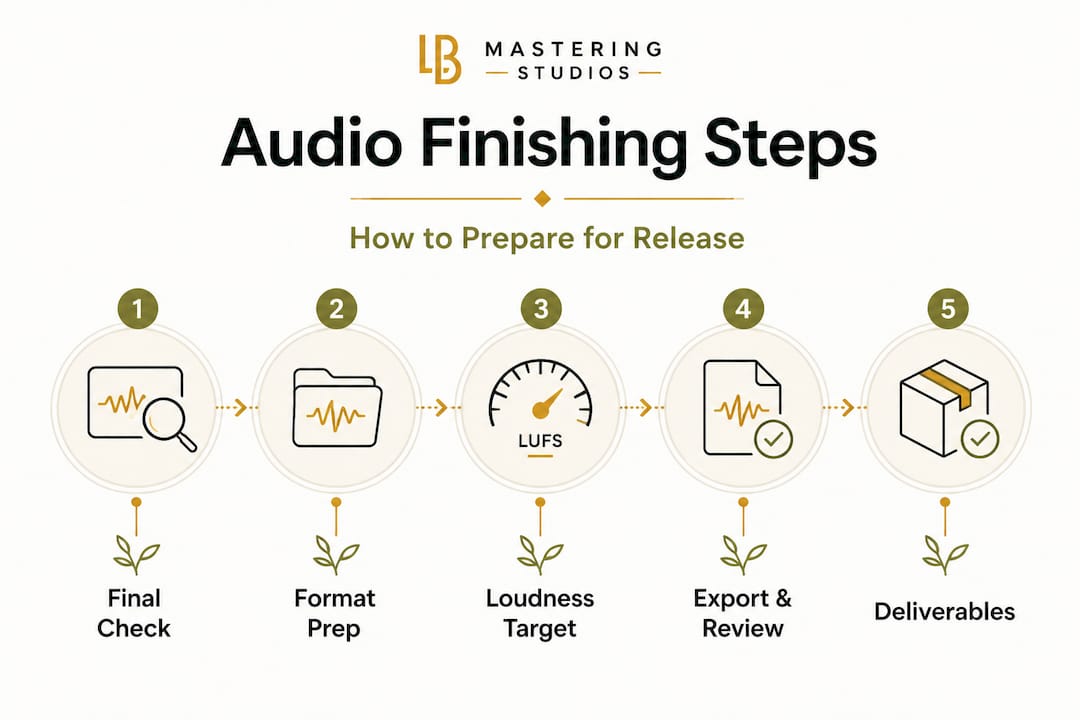
Think of finishing as the professional sign-off. It is the point where the engineer steps back from creative decisions and takes a hard, objective look at the technical integrity of the final files. The question being asked is no longer "Does this sound good?" It becomes "Is this file correct, complete, and compliant for where it is going?"
Key deliverables that emerge from a proper audio finishing workflow include:
- Streaming-ready files: 16-bit/44.1 kHz WAV or FLAC files that meet loudness normalization targets for platforms like Spotify, Apple Music, and TIDAL
- CD-ready DDP image files: Disc Description Protocol files that contain all track data, gaps, and embedded metadata required by replication plants
- Vinyl-specific masters: High-resolution, dynamically appropriate WAV or AIFF files prepared according to the mechanical constraints of vinyl cutting
- Cleaned and labeled assets: Files that are free of artifacts, properly named, and carry correct ISRC codes and metadata
"Without a formal finishing phase, even a beautifully mastered record can fail at the point of delivery. The creative work is done, but the logistical and technical work is not."
We strongly recommend using our essential mastering checklist as your starting reference before entering the finishing phase. It covers the baseline standards your tracks need to meet before any format-specific prep begins.
Key elements of audio finishing
Understanding the concept is step one. Next, let's look at the actionable elements that turn a good mix into a release-ready master.
Finishing is not vague. It follows a structured sequence of checks and tasks that every project needs to pass through before files leave the studio. Here is a clear breakdown of those steps:
-
Quality control listening pass: Every track gets a full-length listen at a calibrated monitoring level. Engineers listen specifically for clicks, digital dropouts, aliasing artifacts, low-frequency rumble, inter-sample peaks, and any noise that wasn't audible during the mix or mastering session. This step catches the problems that would embarrass you at the duplication plant.
-
Level and loudness compliance: Each format has different loudness targets. Streaming platforms use integrated loudness standards (measured in LUFS) and will automatically attenuate files that exceed those targets. CD masters are held to a different loudness curve than vinyl. This step ensures that each format-specific master lands in the correct loudness window without sacrificing dynamic integrity.
-
Metadata and labeling verification: Every delivered file must contain accurate, complete metadata. That means track titles, artist name, album name, ISRC codes, release year, and copyright information. Missing or incorrect metadata causes problems at every level, from digital distribution to performing rights collection.
-
Format-specific file packaging: For CD, this means generating a DDP image. For streaming, it means 24-bit high-resolution masters and 16-bit consumer versions. For vinyl, it means a separate lacquer-ready file. This step also covers sequencing, track gaps, and any required technical documentation.
-
Final approval and sign-off: The engineer reviews everything against the client's brief, confirms all format variants are accounted for, and formally signs off on the project. No further processing is added. The project is done.
Pro Tip: Avoid the common trap of adding new processing during the finishing phase. We see it constantly: a client hears the finished master and wants to tweak the high end "just slightly." Any creative change at this stage means restarting the QC process. Make your creative decisions before finishing begins, not during it.
Finishing can also be understood as the discipline of knowing when a mix or master is truly done, committing to that decision, and then executing the final checks rather than endlessly iterating with new processing. Discipline matters here as much as skill.
Use our downloadable mastering checklist to track each of these steps systematically before you submit your project for duplication or distribution. It takes the guesswork out of the process and gives you a paper trail that proves your files were properly prepared.
Why finishing differs for vinyl vs. digital
But finishing is not one-size-fits-all. Here's why respecting the differences between vinyl and digital delivery is critical and how those impact your workflow.
Digital distribution is relatively forgiving. If your file has a couple of extra decibels of loudness, the streaming platform will normalize it. If the format is wrong, most aggregators will flag it before it publishes. Vinyl is a completely different story. A vinyl master has mechanical constraints: bass needs to be limited and kept mono below certain frequencies to avoid groove instability, and the master needs adequate headroom to avoid clipping and allow the cutting engineer to optimize the cut. Submit a heavily limited digital master to a vinyl plant and you risk poor sound quality, groove distortion, or a full rejection and re-submission fee.

Independent labels often commission separate masters for vinyl and digital streaming deliverables rather than relying on a single master for everything. That practice reflects real-world experience with the distinct technical demands of each format.
Here is a quick comparison of what the finishing requirements look like between the two formats:
| Requirement | Digital streaming | Vinyl pressing |
|---|---|---|
| Target loudness | -14 LUFS (integrated) | Not loudness-based; dynamic priority |
| File format | 16-bit WAV/FLAC or 24-bit hi-res | 24-bit uncompressed WAV/AIFF |
| Headroom | 1 dB true peak | 3 to 4 dB recommended |
| Bass handling | Stereo bass acceptable | Mono bass below 200 Hz required |
| Limiting/compression | Platform normalizes; limiting common | Minimal compression; avoid maximizers |
| Metadata | Embedded tags required | Labeling for plant identification |
| Delivery format | Single track files or album bundle | Full album master, sequential |
Additional vinyl-specific finishing considerations include:
- Side length management: Louder cuts require shorter sides. A 20-minute side at high levels will sound worse than an 18-minute side with proper dynamic range.
- Sibilance control: Excessive sibilance can cause the needle to skip. De-essing and spectral repair may be needed in the finishing phase for vinyl candidates.
- Sequencing and gaps: Vinyl sides need to be sequenced so that the loudest tracks are placed toward the outside of the disc where groove depth is greatest.
- Stereo width at low frequencies: Wide low-frequency energy causes the cutting stylus to move vertically in opposing directions simultaneously, which can cause the groove to fold. Proper bass mono treatment is essential.
"Every format has its own physics. Finishing for vinyl means respecting the mechanical reality of the medium. Finishing for digital means respecting the algorithmic reality of platform normalization."
Our detailed vinyl mastering guide covers all of these technical considerations in depth, and we also break down the full CD mastering process for labels preparing physical releases alongside their streaming rollout.
How to ensure your audio is truly release-ready
With the format-specific requirements clear, it's time to ensure your project meets the finishing standards needed for smooth release.
Vinyl submission guidelines provide concrete benchmarks: deliver high-resolution uncompressed WAV or AIFF files, keep headroom at approximately 3 to 4 dB, and avoid clipping or over-compression so the cutting engineer can create high-quality vinyl-ready cuts. Meeting these benchmarks is not optional if you want a pressing plant to accept your files on the first submission.
Here is a finishing checklist you can run through before you send anything to a distributor or pressing plant:
- Listen to every track in full at a moderate, calibrated volume before signing off
- Check for digital clipping, inter-sample peaks above your target ceiling, and any audible artifacts
- Confirm that loudness targets are format-appropriate and measured with a proper LUFS meter
- Verify that all metadata fields are filled in correctly, including ISRC codes for each track
- Confirm the file format and bit depth match the destination's requirements
- For vinyl: confirm that bass is mono below 200 Hz, headroom is at least 3 dB, and the master has not been maximized
- For CD: confirm that a proper DDP image is generated, not just individual WAV files
- For streaming: confirm that your delivery platform has received the high-resolution master version, not a compressed file
The comparison table below shows the most common finishing failures and how to avoid them:
| Common issue | Digital impact | Vinyl impact | How to prevent it |
|---|---|---|---|
| Over-compression | Sounds flat after normalization | Groove distortion, possible rejection | Use dynamic range tools; target appropriate LUFS |
| Missing metadata | Incorrect credits in distribution | Labeling errors at plant | Complete all metadata fields before export |
| Insufficient headroom | Clipping on some devices | Cutting stylus overload | Leave at least 3 to 4 dB for vinyl; 1 dB for digital |
| Stereo low frequencies | Minor imaging issues | Groove folding, skipping | Apply mono bass processing below 200 Hz |
| Wrong file format | Delivery failure | Rejection or additional fees | Confirm format specs with plant before submitting |
| Unreviewed artifacts | Clicks or pops in final product | Physical groove damage | Full QC listen before every submission |
Use our free audio finishing checklist to make sure none of these issues slip through. And when you're ready to hand off your vinyl project to professionals, our professional vinyl finishing services ensure every mechanical requirement is satisfied before your lacquer is cut.
The real reason audio finishing matters: beyond the technical details
We've covered the steps and the specs. But let's step back and ask why all these final checks and tweaks make such a meaningful difference beyond just checking boxes.
Here's something we've learned across more than 44 years of professional mastering: even experienced engineers miss finishing details. Not because they lack skill, but because they've been listening to the same project for so long that their ears are no longer objective. Familiarity is the enemy of quality control. The finishing phase creates structured distance from the creative process and forces an objective, systematic review that the creative mind often resists.
There's also a practical protection argument. A click buried at the 2:43 mark of your lead single, a vinyl master that gets rejected by the pressing plant three weeks before your release date, a track that shows up on Spotify with someone else's metadata: these are not hypothetical disasters. They happen regularly to independent artists who treat finishing as an afterthought. Proper finishing protects you from those surprises. It is the professional practice of not assuming everything is fine.
Beyond the technical protection, there is a creative peace of mind that comes with knowing your music will sound exactly as you intended across every format and every listening environment. A well-finished record sounds like your vision, whether it is playing on a high-end turntable, a Bluetooth speaker, or a streaming app on someone's phone. That consistency is what finishing delivers. Without it, your music might sound great in your studio and underwhelming everywhere else.
We also believe that finishing is an act of respect for your audience. When someone buys your vinyl or streams your album, they deserve the best possible version of your music. Cutting corners in the finishing phase is the one place where the listener definitely feels the difference, even if they can't name it.
You will find additional mastering insights on our blog, covering topics from analog signal chains to delivery specs for every major streaming platform. Audio finishing is not busywork. It is the difference between just done and truly world-ready.
Get expert audio finishing for your next release
If you're ready to level up your tracks with professional finishing, here's how LB-Mastering can help you take the next step.
At LB-Mastering Studios, we handle format-specific finishing for digital streaming, CD, and vinyl as part of our core service offering. With over 44 years of experience and a hybrid analog-digital signal chain built around vintage gear and modern precision tools, we deliver files that meet every technical requirement while preserving what makes your music special.

Our vinyl mastering services include full mechanical compliance prep, mono bass processing, sibilance control, and side sequencing guidance. We also provide a vinyl guide PDF so you can understand exactly what we're doing and why at every step. Want to know the tools behind the results? Browse our mastering equipment page to see the analog and digital hardware we use to achieve warmth, clarity, and optimal loudness. Contact us today for a free sample master and hear the difference that professional finishing makes.
Frequently asked questions
Is audio finishing different from mastering?
Yes. Finishing includes quality checks and format-specific prep after mastering, ensuring tracks are ready for distribution across all intended platforms and physical formats.
Do I need separate masters for vinyl and digital?
Yes. Each format has unique technical requirements, and separate format masters improve both sound quality and compatibility with distribution and pressing plant specifications.
What's the most common mistake with audio finishing?
Over-compression or insufficient headroom, especially for vinyl, frequently leads to poor sonic results or plant rejection, since clipping or over-compression can require costly re-submission with corrected files.
How do I know my audio is finished?
Your audio is finished when you have completed a full QC review, confirmed format compliance, and committed to the final files without endlessly iterating with additional processing after the fact.