
 comparison
Is Analog Mastering Really Necessary for Streaming?
Table of Contents
- The Role of Mastering in the Digital Age
- Analog vs Digital Mastering for Streaming: The Sonic Reality
- Understanding Loudness Normalization Standards for Streaming
- When Is Professional Mastering Actually Necessary?
- Preparing Your Mix for Streaming Services
- DIY Mastering vs. Hiring a Professional: What Changes
- Common Misconceptions About Analog Mastering for Streaming
- Frequently Asked Questions
Last Updated: September 23, 2026
The Role of Mastering in the Digital Age
Analog mastering streaming has become a critical consideration, yet mastering remains one of the most misunderstood steps in music production. Many artists assume that if their mix sounds good on their studio monitors, it's ready for release, a costly mistake.
Mastering isn't about fixing a bad mix. It's about translating your mix across all playback systems, from studio monitors to smartphone speakers to car stereos, while meeting streaming platform technical requirements.
Streaming services impose loudness normalization standards that conflict with traditional mastering approaches. Your mix might sound powerful in your studio but fall flat after normalization on Spotify or Apple Music. A skilled engineer specializing in analog mastering streaming works within these constraints without sacrificing sonic character.
Analog vs Digital Mastering for Streaming: The Sonic Reality
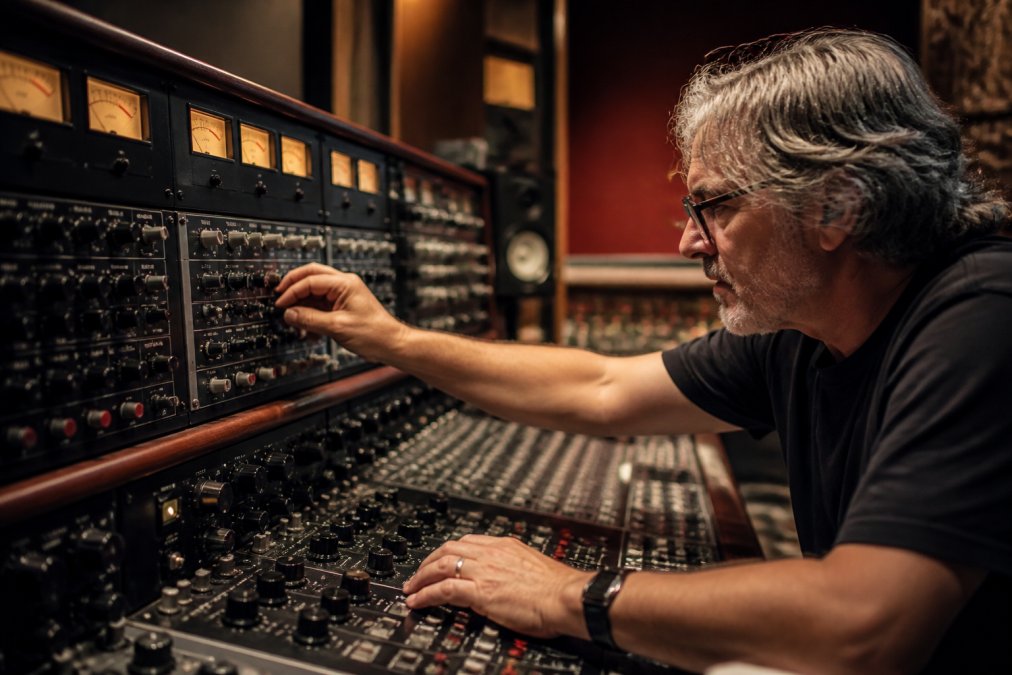
The choice between analog and digital mastering for streaming hinges on understanding what analog hardware does and what gets lost when streaming platforms apply loudness normalization.
The Harmonic Distortion Mechanism
Analog mastering chains introduce harmonic distortion as an inherent byproduct of how electrons move through physical circuits. An analog compressor overshoots slightly, undershoots, and exhibits "soft-knee" behavior, creating subtle harmonic overtones in the 2nd, 3rd, and 5th harmonic series that influence how the brain perceives cohesion and "glue."
Tape saturation adds character by compressing peaks asymmetrically, adding even-order harmonics (2nd, 4th, 6th) that listeners perceive as warmth. Digital plugins model this mathematically with sample-accurate precision, resulting in technical cleanliness but psychoacoustic flatness.
Rock, R&B, and hip-hop mixes often benefit from analog saturation.
The Streaming Normalization Trade-Off
Spotify normalizes all tracks to -14 LUFS; Apple Music targets -16 LUFS. This loudness reduction flattens some harmonic detail from analog mastering.
When Analog Mastering Still Wins
Analog mastering is beneficial for vinyl releases (which preserve dynamic range without normalization), genre-specific character (rock, soul, and R&B often benefit), and long-term catalog positioning.
The Engineer Variable Outweighs the Format
Ask potential engineers how they approach -14 LUFS mastering, whether they've mastered your genre, and for references. The right engineer delivers measurable improvements in how your music translates across playback systems.
Understanding Loudness Normalization Standards for Streaming
Loudness normalization is the biggest factor changing how mastering works for streaming. Spotify normalizes to -14 LUFS, Apple Music to -16 LUFS, and YouTube to -13 LUFS to prevent jarring volume jumps.
If you master to -8 LUFS, Spotify turns it down to -14 LUFS, compressing your dynamics further and flattening transient definition.
Professional mastering engineers now optimize for -14 LUFS while preserving dynamic range and frequency balance, a different mindset than traditional loudness-chasing approaches.
Loudness normalization makes mastering more important, not less. A poor master sounds thin after normalization; a professional master maintains impact and clarity.
When Is Professional Mastering Actually Necessary?
The answer depends on three variables: distribution goals, mix quality, and budget.
The Distribution Goal Framework
Streaming-only release: Professional mastering is essential. Streaming platforms require expertise to navigate loudness normalization standards. A poorly mastered track sounds noticeably thinner than competitors' releases.
Streaming + vinyl release: Professional mastering is critical because vinyl prioritizes dynamic range and harmonic character while streaming optimizes for loudness normalization. A single master rarely serves both formats well.
YouTube uploads, SoundCloud demos, or personal projects: DIY mastering using quality monitoring headphones and reference tracks may be sufficient for lower-stakes releases.
The Mix Quality Assessment
Before deciding on mastering, evaluate your mix objectively:
- Listen on five different playback systems: Studio monitors, laptop speakers, car stereo, earbuds, and phone speakers. Frequency balance issues can be improved but not fully fixed by mastering.
- Check for phase issues: Pan to mono. If elements lose definition or bass disappears, you have phase problems requiring remix work, not mastering.
- Assess dynamic range: Compare your mix to a professional reference track. If your mix bus is heavily compressed, mastering has less room to work.
The Budget-Tier Reality
Budget tier: Automated or AI-driven services using algorithms. Fast and consistent but lack human judgment; work best for excellent mixes needing streaming compliance.
Mid-tier: Professional engineer using quality digital tools in a treated space. Brings trained ears and understanding of streaming loudness standards. Best value for most independent artists.
High-tier: Professional analog mastering with experienced engineers. Justifies cost for vinyl releases, genre-specific character, or full albums.
The Objectivity Problem
Studio environment colors perception. Untreated rooms, consumer-grade monitors, and isolation headphones distort how you hear your mix. After months, your ears adapt to problems you can no longer hear.
A professional mastering engineer works in an acoustically treated space with high-end monitoring and fresh ears, catching problems invisible to you. This objectivity is worth the cost for commercial releases.
The Decision Framework
Ask yourself: (1) Am I releasing commercially on streaming? (2) Does my mix sound balanced across five playback systems? (3) Is my budget flexible? (4) Am I releasing on vinyl or physical formats?
Preparing Your Mix for Streaming Services
Your mix preparation directly impacts how much your mastering engineer can improve your final result.
Start with proper headroom. Leave at least 3-6 dB of space below 0 dB on your mix bus. This gives your mastering engineer room to work without digital clipping. Many artists push their mixes too hot, forcing the mastering engineer to reduce levels before processing. That's wasted opportunity.
Check your mix on multiple playback systems. Your studio monitors tell only part of the story. Listen on laptop speakers, car stereos, earbuds, and phone speakers. If your mix sounds thin on earbuds or boomy in your car, your mastering engineer needs to know that. Reference tracks help here, choose a professionally mastered song in your genre and compare how it translates across systems.
Organize your session logically. If you're doing stem mastering (sending individual tracks or submixes instead of a stereo mix), label everything clearly. Drums, bass, vocals, instruments, clear naming saves time and reduces errors. Some engineers prefer stereo mixes; others prefer stems. Ask your mastering engineer before you deliver files.
Use lossless audio formats. WAV or AIFF files preserve all the information in your mix. MP3 or compressed formats lose data that mastering can't recover.
Remove any limiting or heavy compression from your mix bus. Let your mastering engineer shape the dynamic response. If your mix bus is already limited, you're constraining what the mastering engineer can do.
Provide reference tracks in the same genre. Tell your engineer what you're aiming for sonically. "I want this to sound like [artist]'s latest release" gives your engineer a target to match.
DIY Mastering vs. Hiring a Professional: What Changes
The core difference between DIY and professional mastering is environment, equipment, and experience.
DIY mastering typically happens in untreated rooms with consumer-grade monitors and headphones. You're fighting your environment. Reflections, standing waves, and room resonances color what you hear. Your ears also fatigue quickly when you're making critical decisions about your own work. Objectivity suffers when you've been living with these songs for months.
Professional mastering happens in acoustically treated spaces designed specifically for critical listening. The engineer has trained their ears over years to catch problems invisible to untrained listeners. They use high-end monitoring systems that reveal frequency issues you can't hear on consumer equipment. Most importantly, they bring fresh ears, they're hearing your mix for the first time, which reveals obvious problems that familiarity has hidden from you.
The equipment difference is significant. Professional analog mastering chains include compressors, EQs, and tape machines. A single piece of analog gear can offer unique sonic characteristics. The harmonic character of analog processing adds dimension that purely digital workflows struggle to match.
For artists on budget, the practical choice is often a hybrid: do careful DIY mixing, then send your stereo mix to a professional mastering engineer. This balances cost and quality. You save money by mixing yourself, but you get professional mastering that ensures your music meets technical standards and translates across playback systems.
Common Misconceptions About Analog Mastering for Streaming
Several myths persist about analog mastering that mislead artists into making poor decisions.
Myth 1: Analog mastering is always better than digital.
Analog gear can add valuable character, but the best choice depends on your goals, not on the format itself.
Myth 2: You need analog mastering to compete commercially.
Many commercially successful releases use entirely digital mastering chains.
Myth 3: Mastering can fix a bad mix.
Myth 4: Loudness normalization makes mastering irrelevant.
Myth 5: All mastering engineers produce similar results.
Frequently Asked Questions
What's the actual difference between analog mastering and AI mastering for streaming releases?
Analog mastering uses physical hardware like compressors, EQs, and saturation units to shape your audio, adding harmonic distortion and transient response characteristics that digital-only processing cannot replicate. AI mastering applies algorithms to achieve loudness standards and basic EQ balancing instantly, but lacks the nuanced decision-making and analog warmth. For streaming, analog mastering preserves headroom and dynamic range while meeting LUFS requirements, whereas AI tools often prioritize loudness uniformity over sonic character.
Do streaming platforms like Spotify actually change the sound of my master after I upload it?
Yes. Streaming platforms apply loudness normalization to match their integrated loudness standards (Spotify targets -14 LUFS). This means your master's peak limiting and dynamic range are preserved, but the playback volume adjusts automatically. If your mix has poor frequency balance or clipping artifacts, normalization won't fix those, they'll still be audible. A professionally mastered track with proper headroom and clean signal chain translates better across all streaming services and playback devices.
Is analog mastering worth the investment if I'm only releasing on streaming platforms?
It depends on your goals and budget. If your mix has solid fundamentals and you're competing in a crowded genre, professional analog mastering ensures your track meets technical streaming requirements while preserving sonic fidelity and dynamic range. Independent artists with tight budgets might start with hybrid approaches or professional digital mastering. However, if you plan long-term releases, vinyl variants, or licensing opportunities, analog mastering provides flexibility and sonic quality that scales across all distribution formats.
What technical requirements do I need to meet before sending my mix to a mastering engineer?
Provide a stereo mix at 24-bit depth and 44.1 kHz or 48 kHz sample rate, leaving at least -3dB of headroom on your mix bus to prevent digital clipping during processing. Avoid excessive compression or limiting on your master bus, let the mastering engineer handle that. Include reference notes on your mix intent, any specific loudness targets, and whether you need masters for streaming, CD, or vinyl. A professional mastering engineer will guide you through any technical issues and may request stems if your mix needs detailed attention.