
 ultimate-guide
Mastering for CD, Stem, and Vinyl in Podcast Production
Table of Contents
- Why Podcast Producers Need Format-Specific Mastering
- Vinyl Mastering Requirements for Podcasts
- CD Mastering: Sample Rate, Bit Depth, and DDP Delivery
- How to Prepare Stems for Professional Mastering
- Audio Mastering Best Practices for Physical Media
- Cost-Benefit Analysis: Physical Formats vs. Digital-Only Release
- What to Expect From a Professional Mastering Session
- Conclusion
Last Updated: August 30, 2026
Mastering for CD, stem, and vinyl formats in podcast production is more technically demanding than most podcasters expect. The format you choose determines every technical decision that follows, from frequency response targets to delivery file specifications. At LB-Mastering Studios, we work with podcast producers increasingly moving beyond digital-only releases to press vinyl and manufacture CDs. The gap between a serviceable digital master and a format-ready physical master is wider than most realize.
A single stereo master optimized for streaming will not cut cleanly to lacquer, will not meet Red Book CD standards, and will not give a stem-based project the flexibility it needs for future mixing. Below, we walk through exactly what each format demands, where most projects go wrong, and what a professional mastering session delivers.
Why Podcast Producers Need Format-Specific Mastering
Format-specific mastering tailors every technical parameter to the physical or digital medium that will carry it. Digital mastering targets loudness normalization standards set by platforms like Spotify and Apple Podcasts, which follow the AES streaming loudness recommendations. Physical media operates under entirely different constraints. Vinyl is governed by physical cutting laws. CD follows strict Red Book specifications. Stems require their own gain structure and labeling conventions.
Treating all three as interchangeable is the most common and most costly mistake in physical podcast production.
| Format | Primary Constraint | Delivery Requirement | Key Technical Focus |
|---|---|---|---|
| Vinyl | Lacquer cutting physics | Reference lacquer or WAV | Low-end mono, stereo width, dynamic range |
| CD | Red Book standard | DDP image or physical master | 16-bit/44.1kHz, peak limiting |
| Stems | Gain staging & labeling | Exported tracks at session level | Headroom, phase correlation, labeling |
| Streaming | Loudness normalization | WAV or FLAC stereo master | Integrated LUFS target, true peaks |
Vinyl Mastering Requirements for Podcasts
Vinyl mastering is not a louder or warmer version of your streaming master. It is a distinct engineering discipline governed by the physical limitations of the lacquer cutting process.
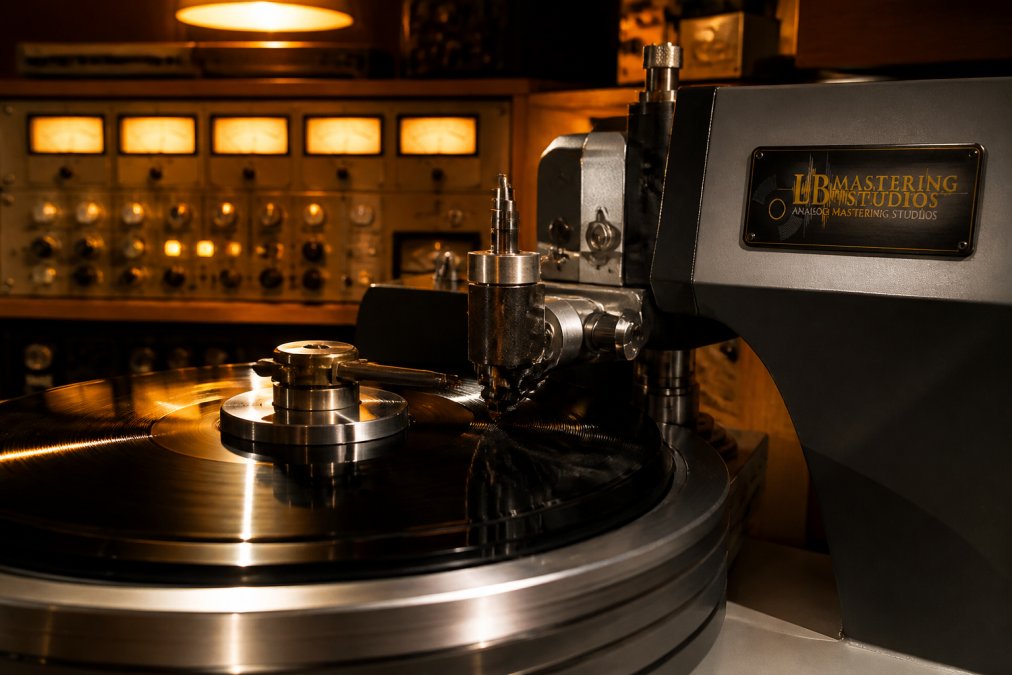
When audio is cut to lacquer, a cutting stylus physically carves a groove into a lacquer disc. The geometry of that groove determines what the playback stylus can track without skipping or distorting. Every frequency, dynamic, and stereo decision either helps or fights that physical process.
Physical Constraints Every Podcaster Must Understand
The lacquer cutting engineer works within hard physical limits that no amount of digital processing can override.
Side length determines loudness. For a 12-inch record at 33 RPM, keep each side under 18-20 minutes to maintain adequate volume and fidelity (aes.org). Podcast episodes running 45-60 minutes are not directly pressable to a standard LP without editing or a multi-disc format.
Low-frequency content must be mono. Stereo low-frequency energy causes the cutting stylus to move both laterally and vertically, risking groove jumps during playback. Everything below 100-150 Hz is summed to mono. Stereo bass elements, music beds, or sound design with heavy low-end imaging will be altered during cutting.
Transient response is limited. Sharp, high-amplitude transients can cause the cutting stylus to run out of groove wall. Peak limiting and careful dynamic range management are essential before lacquer cutting.
Inner groove distortion increases toward the label. Audio near the record center has less linear velocity than audio near the outer edge. High-frequency content becomes increasingly difficult to cut cleanly as the stylus approaches the label.
EQ, Dynamic Range, and Phase Correlation for Vinyl
RIAA equalization is applied as part of the cutting process. Bass frequencies are attenuated before cutting and boosted on playback. The mastering engineer must account for how the RIAA curve interacts with your program material's frequency response.
Dynamic range is preserved more than in streaming masters. Vinyl rewards a more dynamic master. Aggressive peak limiting and heavy RMS compression create pumping artifacts and reduce audio fidelity on playback.
Phase correlation is critical. Out-of-phase stereo content creates a vertical groove cut that causes playback issues. A phase correlation meter should show predominantly positive values across the mix before vinyl mastering begins.
Stereo width management involves narrowing the stereo image at low frequencies to ensure a stable, trackable groove. This does not mean your record will sound mono, the stereo image is managed within the physical tolerances of the format.
CD Mastering: Sample Rate, Bit Depth, and DDP Delivery
CD mastering follows the Red Book standard, the specification established by Sony and Philips that defines technical parameters for audio CDs. Every pressing plant requires masters that conform to this standard.
The Red Book standard specifies 16-bit audio at 44.1 kHz sample rate. If your podcast is recorded at higher bit depth, such as 24-bit at 48 kHz, the mastering process includes conversion and dithering to reach the 16-bit/44.1 kHz target. Dithering adds low-level noise to mask quantization artifacts introduced during bit-depth reduction. Skipping dithering produces audible distortion in quiet passages, particularly in spoken word content.
Peak limiting for CD targets a maximum true peak level of -0.1 dBFS or lower. According to Audio Engineering Society technical standards, proper inter-sample peak management is essential for CD masters intended for consumer playback.
DDP Image Files vs. Physical CD Masters
Most professional pressing plants now require a DDP image rather than a physical CD-R master. A DDP image is a Disc Description Protocol file set containing complete audio, PQ subcodes, CD-Text, and ISRC codes. It eliminates the risk of physical media degradation during shipping and is the industry standard for professional CD manufacturing.
Your DDP image should include:
- Correctly sequenced tracks with accurate PQ subcode markers
- ISRC codes for each track (required for royalty tracking)
- CD-Text data including artist name, album title, and track titles
- A verified checksum to confirm file integrity during transfer
- A reference audio file for the pressing plant to compare against
Approving the reference audio before DDP delivery is essential, as revisions after DDP creation require regenerating the entire image.
How to Prepare Stems for Professional Mastering
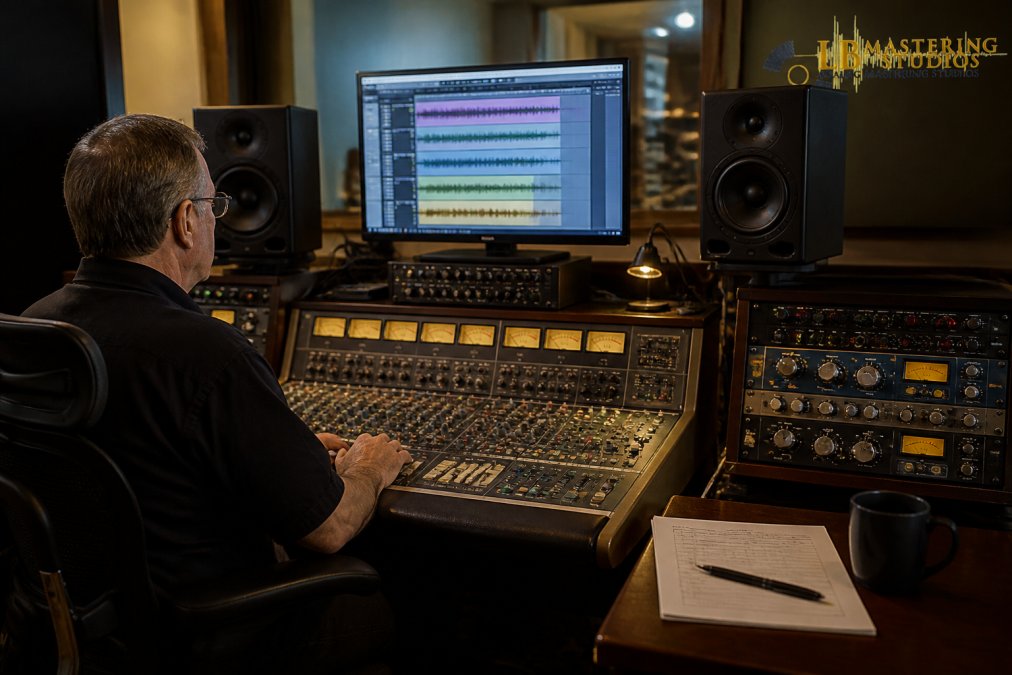
Stems are grouped, pre-mixed audio exports that give the mastering engineer more flexibility than a single stereo mix. For podcast production, stems typically include separate exports for dialogue, music, sound effects, and ambience.
Stem Labeling, Gain Staging, and Headroom
Labeling conventions eliminate ambiguity. Name each stem file to identify its content, role, and session position: EP12_DIALOGUE_STEM_01.wav or EP12_MUSIC_BED_STEM_02.wav.
Gain staging refers to the level relationship between your stems and the final stereo mix. Export each stem at the same gain level it held in your mix session. Do not normalize individual stems before export, normalization destroys the gain structure the mastering engineer needs.
Headroom is the space between peak level and 0 dBFS. For stem delivery, a peak level of -6 dBFS or lower on any individual stem is a widely used target.
Additional stem preparation requirements:
- Export all stems at the same sample rate and bit depth as your session (24-bit, 48 kHz is common)
- Ensure all stems start at the same timecode position so they align on import
- Include a summed stereo reference mix at the same level as the stems
- Confirm phase correlation between stems by summing them in your DAW
- Remove any limiting or heavy compression from the master bus before exporting stems
Audio Mastering Best Practices for Physical Media
Audio mastering best practices for physical media differ from streaming-focused workflows. The goal shifts from loudness competition to audio fidelity and format compatibility.
Managing Sibilance, High-Frequency Content, and Stereo Width
Sibilance is the harsh, high-frequency energy produced by consonants like "s," "sh," and "t" in spoken word recordings. For podcast content, sibilance management is one of the most technically demanding aspects of mastering for physical media.
On vinyl, sibilance is particularly problematic near inner grooves where linear velocity decreases. Excessive sibilance can cause stylus skip or distortion. A de-esser is standard practice, but over-de-essing produces unnatural quality. The target is reduction, not elimination.
On CD, sibilance affects listener fatigue. Gentle de-essing and high-frequency management ensure content is listenable at reference levels across playback systems.
Stereo width on physical media requires different handling than streaming. For vinyl, low-frequency stereo content must be controlled. For CD, stereo width can be maintained more freely, but mid-side processing should be applied carefully.
A practical checklist for high-frequency and stereo management:
- Apply de-essing to dialogue tracks before mastering
- Check mono compatibility by summing the stereo master and listening for phase cancellation
- Use a phase correlation meter: values consistently below zero indicate phase problems
- Apply a high-pass filter to remove subsonic energy below 20 Hz
- Verify stereo width with a goniometer before approving the vinyl reference
Cost-Benefit Analysis: Physical Formats vs. Digital-Only Release
The decision to press vinyl or manufacture CDs involves real tradeoffs beyond audio quality. Physical formats require larger upfront investment, longer production timelines, and more complex distribution logistics than digital-only releases.
The case for physical formats is strongest when the content has a dedicated audience willing to pay for a premium collectible, the podcast is a limited-run series with a defined narrative arc, or the producer intends to sell merchandise at live events or through direct-to-consumer channels.
The case for digital-only release is stronger when the episode catalog is large and ongoing, the audience is primarily discovery-driven rather than collector-oriented, or the production budget is limited.
Many producers find a hybrid approach works well: a digital master for streaming distribution, plus a limited vinyl pressing or CD run for a specific season or anniversary release. This allows testing the market for physical product without committing to a full pressing run before demand is confirmed.
Physical format production timelines are also a practical consideration. Pressing plants currently have lead times extending from several weeks to several months depending on demand and format. Planning for physical release requires building mastering, plant scheduling, and shipping time into the production calendar well in advance.
What to Expect From a Professional Mastering Session
A professional mastering session for physical media follows a structured workflow that differs from automated or self-service mastering tools.
Step 1: Source material review. The mastering engineer evaluates incoming audio for technical issues: clipping, excessive limiting, phase problems, sibilance, and gain staging.
Step 2: Format-specific signal chain setup. For vinyl, the signal chain includes EQ tailored to the RIAA curve, dynamic range management, stereo width control, and de-essing. For CD, the chain focuses on peak limiting, dithering, and loudness targeting. For stem-based projects, the engineer assembles the stems and balances them before applying mastering processing.
Step 3: Reference listening and approval. The engineer produces a reference master for producer approval. This is the critical revision stage. Changes to the reference are less costly than changes after DDP creation or lacquer cutting.
Step 4: Format delivery. Approved masters are delivered in the format required by the pressing plant or distribution platform.
What separates professional mastering from automated alternatives is the engineer's ability to hear and respond to the specific characteristics of your content. Spoken word audio, sound design, and music beds each behave differently under processing, and the decisions made in mastering, particularly for vinyl, require judgment that no algorithm currently replicates reliably.
Physical media production for podcasts demands technical precision that most digital-only workflows never require. From managing phase correlation for lacquer cutting to generating a compliant DDP image for CD manufacturing, every format has specifications that must be met before a pressing plant will accept your master. LB-Mastering Studios offers customized mastering for CD, stem, and vinyl formats for podcast production, backed by 44 years of professional experience and a Latin GRAMMY Award-winning engineer with 11x Billboard-charting credentials. The studio's analog mastering facility and premium outboard gear are purpose-built for exactly this kind of format-specific work. Book a session with LB-Mastering Studios and get a free sample master to hear the difference before committing to a full project.
Frequently Asked Questions
Is mastering for vinyl necessary, or can you use a digital master?
Vinyl mastering is a separate, specialized process, you cannot simply press a digital master to vinyl. The lacquer cutting process imposes strict physical constraints: excessive low-end energy, wide stereo bass, and sharp transients can cause the cutting stylus to skip grooves or damage the lacquer. A dedicated vinyl master adjusts EQ, dynamic range, phase correlation, and stereo width specifically for the cutting lathe, ensuring audio fidelity survives the analog conversion from signal chain to physical media.
What are the technical differences between mastering for CD and vinyl?
CD mastering targets a 44.1 kHz sample rate and 16-bit depth, delivered as a DDP image file to the pressing plant. Loudness normalization, inter-sample peaks, and dithering are the primary concerns. Vinyl mastering, by contrast, requires mono low-end below roughly 150 Hz, controlled stereo width, managed sibilance, and significant dynamic range headroom to prevent groove distortion. The lacquer cutting engineer also plays a role that has no CD equivalent, physically translating the audio signal into groove geometry.
How do stem masters improve flexibility for podcast production?
Stem-based mastering gives the engineer individual control over grouped elements, dialogue, music beds, sound effects, and transitions, rather than working from a single stereo bounce. This means EQ and peak limiting decisions can be applied per element, preserving transient response in spoken word while controlling dynamic range in music. For podcast producers releasing on both streaming platforms and physical media, stems allow the mastering engineer to create format-specific masters from the same source material without returning to the original mix session.
Do podcasters need separate masters for different distribution formats?
Yes. Each format has distinct technical requirements. Streaming platforms apply loudness normalization, so a master optimized for vinyl's wider dynamic range will sound different on Spotify than intended. CD pre-mastering requires specific sample rate and bit depth settings with DDP delivery. Vinyl demands mono low-end and controlled stereo image. A single master cannot satisfy all three simultaneously. Format-specific mastering ensures your audio fidelity holds across every distribution channel, from digital streaming to physical media pressing plants.
What should I send a mastering engineer, stems or a stereo mix?
For standard mastering, a high-resolution stereo mix exported at 24-bit depth and 48 kHz or higher is sufficient. Leave at least -3 dBFS of headroom, do not apply limiting or loudness normalization to the export. For stem-based mastering, group your tracks into logical buses (dialogue, music, effects), export each stem at the same resolution and with identical start times so they align perfectly. Include a rough mix reference so the engineer understands your intended balance before making any adjustments.
This article was written using GrandRanker