 blog
blog
Analog vs Digital Vocal Processing: 2026 Comparison
Table of Contents
- Analog vs Digital Vocal Processing: What Actually Changes the Sound
- Analog Vocal Compressor vs Plugin: Attack, Release, and Level Matching
- Hardware EQ vs Plugin EQ: Frequency Response and Coloration
- Hybrid Vocal Processing: Gain Staging and Converter Choices
- Building a Vocal Mixing Signal Chain for Different Goals
- Latency, Recall, and Session Collaboration in 2026
- Conclusion: Choosing Your Approach and Next Steps
- Frequently Asked Questions
Last Updated: October 13, 2026
Analog vs Digital Vocal Processing: What Actually Changes the Sound
An analog vs digital vocal processing comparison comes down to one distinction: analog passes a continuously varying electrical signal through physical circuits, while digital converts that signal into numbers, manipulates them, and converts them back.
Below, we break down where the audible differences live, how to compare them fairly, and how to build a vocal chain that uses both.
Analog audio is sound represented as a continuous electrical waveform, where every moment of the performance exists as a specific voltage. Digital audio is that same sound captured as discrete samples, measured thousands of times per second and stored as numbers.
Continuous Waveforms vs Discrete Samples
A continuous waveform has no steps: the signal rises and falls smoothly, and every nuance lives in the voltage itself. Digital audio samples that waveform at a fixed rate; higher sampling rates capture more frequency detail and greater bit depth captures more level detail. Once those numbers exist, they can be copied, edited, and recalled with perfect precision, the digital advantage. The analog advantage is behavior: circuits react to signal in ways that are difficult to model exactly, which is why certain compressors and equalizers have signatures engineers recognize instantly.
Warmth, Hiss, and Signal-to-Noise Ratio
"Warmth" is not a setting. It is usually a combination of gentle harmonic distortion, a slight high-frequency roll-off, and transformer or tube coloration that adds low-order harmonics to the source.
Analog chains also add noise: tape hiss, circuit noise, and the cumulative noise floor of every device stack up, lowering the signal-to-noise ratio. Digital chains add no meaningful noise between stages, so the noise floor is set almost entirely by the microphone, preamp, and converter. That matters more on quiet, intimate vocals than on loud, dense ones, a whispered verse exposes hiss, a belted chorus buries it.
Analog Vocal Compressor vs Plugin: Attack, Release, and Level Matching
The analog vocal compressor versus plugin question is really about timing and behavior. A hardware compressor responds with its own circuit's speed and gain-reduction curve; a plugin models that in code, and the model's quality determines how close it gets. Attack and release show the differences first. Set a fast attack on hardware and it grabs transients with a characteristic snap; set the same numbers on a plugin and the result depends on how the developer handled program-dependent behavior, the way a real circuit reacts differently to a snare hit than to a sustained note.
Where Analog and Digital Compression Actually Diverge on Vocals
Four mechanisms separate the two in practice:
- Detector behavior. Optical and vari-mu circuits have a soft, level-dependent knee that eases into gain reduction; most digital compressors use a fixed ratio and threshold unless a soft knee is explicitly modeled. On a dynamic vocal, that shows up as a more natural squeeze on the analog side and a more obvious grab on the digital side.
- Release shape. Hardware release is rarely linear, it slows as gain reduction deepens. Many plugins approximate this with a two-stage release, but the curve is still an approximation. On sustained notes, analog release tends to breathe; digital release tends to pump if pushed.
- Harmonic content under gain reduction. Transformer and tube stages add low-order harmonics as they compress; a clean digital compressor adds none. That is why an analog compressor can sound thicker at the same gain reduction, the coloration is part of the compression, not a separate effect.
- Makeup gain behavior. Analog makeup gain often runs through the same coloration stage, so pushing it changes tone; digital makeup gain is usually transparent, cleaner but less characterful.
A Controlled, Level-Matched Comparison
Most comparisons are worthless because the levels are not matched. A louder signal always sounds "better," so any test where one path is even slightly hotter produces a false winner.
A fair test looks like this:
- Split the same vocal take to both paths
- Set gain reduction to the same amount, watching the meters
- Match output level within a fraction of a decibel
- Bypass and switch without knowing which is which
- Repeat across several vocalists and styles
Run this way, trained listeners often still hear a difference, but the preference splits, some vocalists suit the hardware, some do not. Controlled listening can establish whether a difference is audible under matched conditions; it cannot establish which one is "better," which depends on the song, the performance, and the target sound.
Matching Settings Across Platforms
A common mistake is copying knob positions from hardware onto a plugin and expecting the same result. The numbers do not translate: a hardware 4:1 ratio with a slow attack may behave like a plugin's 3:1 with a medium attack because the detector curves differ. Match the outcome instead, same gain reduction on the loudest phrase, same release feel on sustained notes, then adjust by ear, and document what you actually set, not what the panel says.
Hardware EQ vs Plugin EQ: Frequency Response and Coloration
Hardware EQ versus plugin EQ comes down to what the circuit does beyond the curve you dial in. An analog equalizer's frequency response is shaped by its components: transformers, capacitors, inductors, and tubes all contribute subtle coloration a frequency graph does not show. Plugins can match the curve closely; what they vary on is saturation, phase behavior, and how the circuit reacts when pushed. A well-made analog model captures much of this, a basic digital EQ captures none of it, and that is fine, because sometimes you want a clean, surgical cut with no coloration at all.
The practical split:
- Surgical work (notching resonances, tightening low end): digital EQ wins on precision
- Tone shaping (adding weight, air, or attitude): analog or analog-modeled EQ earns its place
- Bus and mastering duties: coloration compounds across a full mix, so the choice matters more
Hybrid Vocal Processing: Gain Staging and Converter Choices
Hybrid vocal processing means running some stages in hardware and some in the box, which is how most professional rooms now work. The advantage is real: analog tone where it counts, digital recall everywhere else. The cost is complexity, and the place it bites is gain staging.
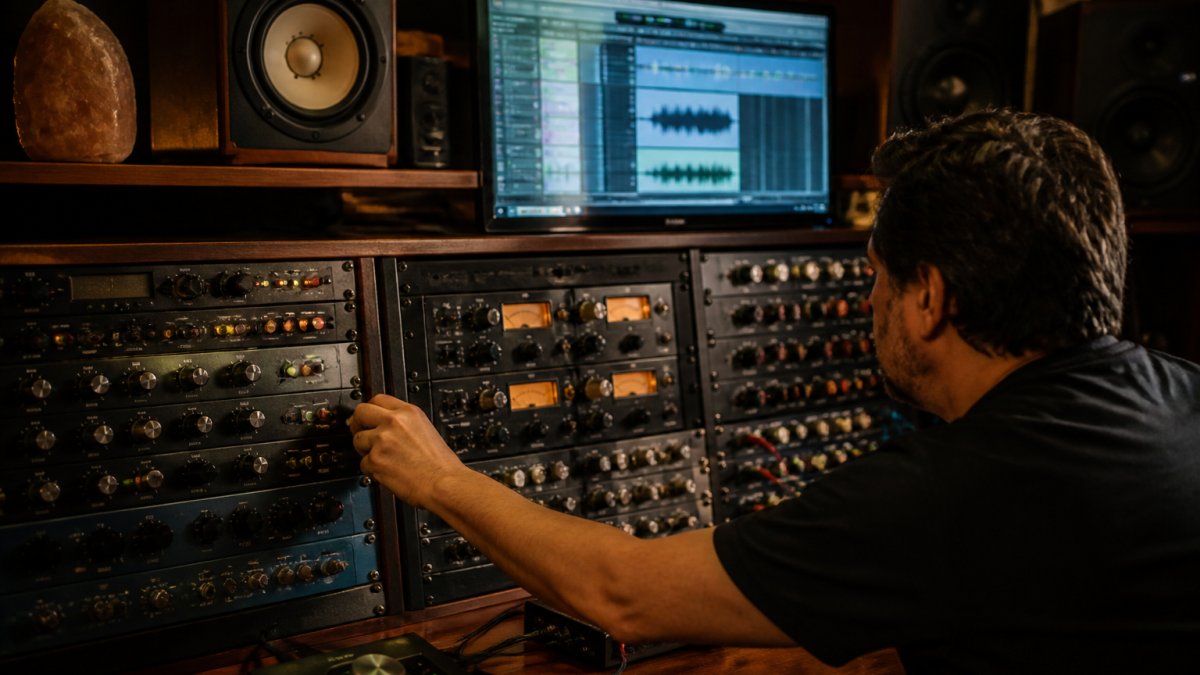
Converter quality also matters more in a hybrid setup than a fully digital one, because you hear the conversion on every pass. That is one reason a dedicated mastering room with premium outboard gear still has an edge: the signal path is chosen and maintained as a whole system rather than assembled piece by piece.
Building a Vocal Mixing Signal Chain for Different Goals
A vocal mixing signal chain is the ordered sequence of processors a vocal passes through, and the order matters as much as the individual choices. The general principle is corrective first, creative second. The more useful question for an analog-versus-digital comparison is: at each stage, does hardware earn its place, or does a plugin do the job better? That decision changes with the vocal goal.
Stage-by-Stage: Where Analog Wins and Where Digital Wins
EQ. Digital wins on surgical work, notching resonances, tightening low end, taming problem frequencies.
Compression. Analog earns its place when the vocal needs character and program-dependent behavior, a lead that must feel controlled but not squashed.
Saturation. Analog has the clearest edge here.
De-essing. Digital wins almost without exception.
Reverb and delay. Analog hardware reverb (plates, springs, chambers) has a character plugins model well but rarely nail exactly. Digital reverb wins on flexibility, recall, and multiple instances.
Chain Examples for Clean, Intimate, Aggressive, and Vintage Vocals
The default order still applies, cleanup, dynamics, tone, space, color, but the analog-versus-digital split changes with the goal.
Clean and modern. Digital EQ for surgical cuts, a clean digital compressor for level control, digital de-esser, digital reverb on a send.
Intimate and close. A gentle analog-modeled compressor early for program-dependent control, a high-pass filter, minimal EQ, a short plate reverb.
Vintage and warm. Analog EQ for tone shaping, an optical or vari-mu style compressor, tape-style saturation, and a spring or plate reverb.
| Goal | First Stage | Dynamics | Tone | Space | Analog or Digital Lean |
|---|---|---|---|---|---|
| Clean | Digital surgical EQ | Clean digital comp | Digital de-esser | Digital verb | Digital |
| Intimate | Gentle analog-modeled comp | Light control | Minimal EQ | Short plate | Mostly digital |
| Aggressive | Analog saturation | Slower attack comp | Mid push | Room verb | Mostly analog |
| Vintage | Analog EQ | Optical/vari-mu comp | Tape saturation | Spring/plate | Analog |
When to Print Hardware and When to Stay in the Box
A practical rule: print hardware when the coloration is part of the sound and you want it committed; stay in the box when you need recall, when the client may ask for revisions, or when the stage is corrective rather than creative. Most working engineers track and mix with hardware where it counts, then deliver and revise with plugins, the hybrid approach that keeps both tone and flexibility.
Latency, Recall, and Session Collaboration in 2026
Latency and recall decide which approach survives a real session. Digital processing wins on recall without argument: a plugin chain reopens exactly as saved, on any machine, months later.
Latency is the analog trade-off. Every converter round trip adds delay, and in a hybrid setup with several outboard passes, that delay can push a vocal out of time with the backing track.
Collaboration has shifted the balance further toward digital. Sessions now move between rooms and cities, and a plugin chain travels with the session file. Hardware does not.
Conclusion: Choosing Your Approach and Next Steps
The real decision is not analog or digital. It is which stages deserve hardware and which are better served by recall and precision. Get that split right and the vocal sounds finished; get it wrong and no amount of gear rescues it.
If you would rather hand that decision to someone who has made it thousands of times, we can help. LB-Mastering Studios offers single song mastering, stem mastering, album mastering, vinyl mastering, and mixing, all handled in a room built around premium analog outboard gear and led by a Latin GRAMMY Award-winning, 11x Billboard-charting engineer with over 44 years of experience.
Frequently Asked Questions
What is the difference between analog and digital vocal processing?
Analog vocal processing passes audio as a continuous electrical signal through hardware like compressors, EQ units, and preamps. Digital vocal processing converts that signal into discrete samples using an audio interface's A/D conversion, then applies plugins inside a DAW. The practical differences show up in noise floor, recall, latency, and how each format handles transients and saturation. Neither is automatically better; the right choice depends on your workflow, budget, and the sound you want.
Can digital plugins recreate the sound of analog vocal gear?
Modern plugins model specific circuits, transformer behavior, and harmonic distortion, so they get close on many sources. In a controlled, level-matched comparison, the gap narrows further. Where plugins still differ is in dynamic response to fast transients and in the subtle nonlinearities that vary unit to unit in hardware. For most vocal mixing signal chain decisions, a well-modeled plugin delivers the character you need without the maintenance or recall limits of hardware.
Is a hybrid analog and digital vocal chain worth using?
Hybrid vocal processing lets you track or print through analog gear for tone and glue, then edit and automate in the box for precision. The main trade-offs are gain staging across converters, latency during tracking, and session recall. If you work on multiple revisions or collaborate remotely, keep the analog stage simple and document every setting. If you print once and commit, a fuller analog path can pay off.
How do you compare analog hardware and digital plugins fairly?
Match levels first, because louder almost always sounds better. Use the same performance, bypass the plugin's oversampling if it changes latency, and compare in short passes to avoid ear fatigue. Listen for how each option handles attack, release, and harmonic saturation on the same vocal phrase. A level-matched comparison removes the biggest source of bias and gives you a real answer about which tool suits the track.