
 listicle
Essential Analog Outboard Gear for Vocal Processing
Table of Contents
- Analog Vocal Chain Signal Flow: From Preamp to Compressor
- Best Analog Compressors for Vocals: FET, Opto, and VCA
- Tube vs Solid State Preamps for Vocals: Which Adds the Right Color?
- Channel Strips vs. Discrete Components: Choosing Your Workflow
- 500-Series Modular Systems: Flexibility Meets Analog Warmth
- Hybrid Workflow Integration: A/B Comparison and DAW Latency
- Genre-Specific Vocal Chains and Maintenance Tips
- Conclusion: Elevate Your Vocals with Expert Analog Processing
- Frequently Asked Questions
Last Updated: September 17, 2026
Analog Vocal Chain Signal Flow: From Preamp to Compressor
Essential analog outboard gear for vocal processing follows a fixed signal path: microphone into preamp, preamp into equalizer, equalizer into compressor, compressor into your converter. Order matters as much as the gear itself.
At LB-Mastering Studios, we run this chain daily. The signal chain is the ordered path an audio signal travels through each device before reaching your recording medium. Get the order wrong and you fight problems downstream that never needed to exist.
Gain staging at the preamp determines how hard you can drive everything after it. Push a transformer-coupled preamp too hard and you get unwanted harmonic distortion; run it too cold and the compressor has nothing to grab.
A common mistake is treating the chain as a list of cool boxes rather than a system. The preamp sets level and color. The EQ carves space. The compressor controls dynamic range. Miss that logic and you're just stacking noise.
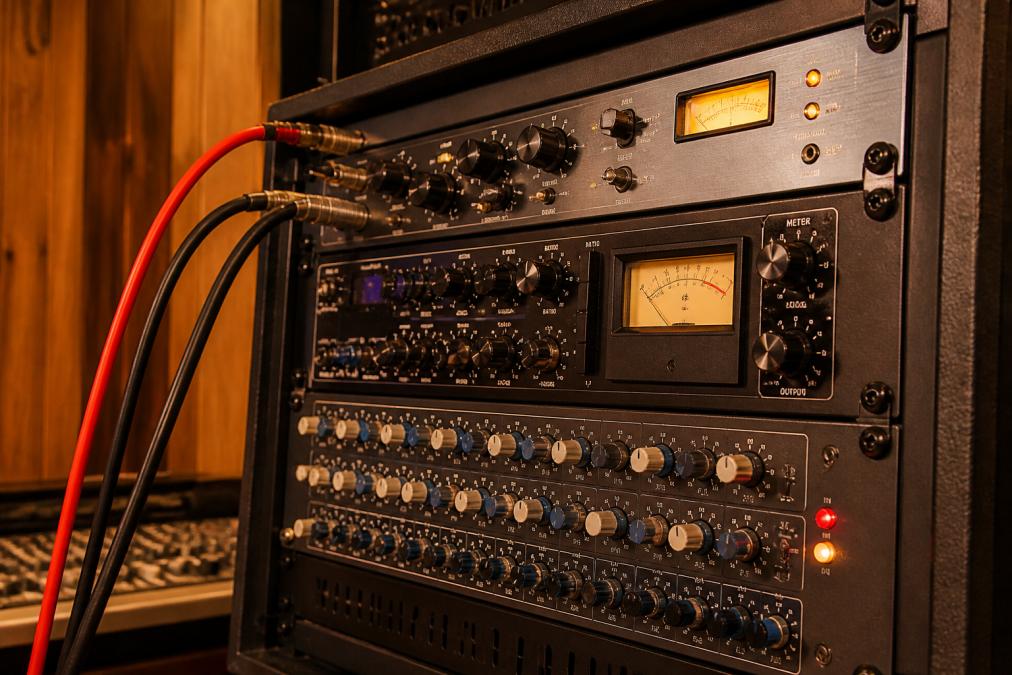
Best Analog Compressors for Vocals: FET, Opto, and VCA
The best analog compressor for vocals depends on what you need it to do. FET compressors deliver fast, aggressive peak reduction. Opto compressors respond slowly and musically. VCA units sit in between, offering control without heavy coloration.
FET designs use field-effect transistors to achieve attack times fast enough to catch hard consonants, making them ideal for vocal tracking. The tradeoff: FET units can sound clinical if you over-compress.
Opto compressors use a light-dependent resistor that reacts gradually, like your ear. For ballads and vocals that need to breathe, opto is the safer pick: attack and release are program-dependent, so compression follows the performance instead of fighting it.
VCA compressors offer precise threshold, ratio, and makeup gain control. They're the least colored of the three, useful when you want compression without a strong sonic signature.
| Compressor Type | Speed | Best For | Sonic Character |
|---|---|---|---|
| FET | Very fast | Tracking, peak control | Aggressive, punchy |
| Opto | Slow, program-dependent | Ballads, smooth vocals | Warm, musical |
| VCA | Adjustable | Bus work, precise control | Neutral, clean |
The Audioscape 76D is a solid FET example, with an all-discrete signal path and attack times fast enough to catch vocal transients. If you want classic peak-limiting character without hunting a vintage unit, it's worth a look.
Tube vs Solid State Preamps for Vocals: Which Adds the Right Color?
Tube preamps add harmonic richness and a softer top end. Solid state preamps deliver faster transient response and a cleaner, more accurate capture. Neither is better; they solve different problems.
Tube saturation introduces even-order harmonics, which engineers describe as "warmth." That character flatters vocals that sound thin or harsh in the upper mids. The Neumann U 67 is the reference point, a tube condenser whose output transformer and tube circuitry have defined vocal recording for decades.
Solid state designs with discrete circuitry and transformer-coupled outputs give you vocal presence and detail without added coloration. If your singer already has a rich, full tone, a clean preamp preserves it instead of layering more character on top.
The Warm Audio WA73-EQ splits the difference: a British-style preamp with discrete Class-A circuitry, custom-wound Carnhill transformers, and an inductor-based 3-band EQ. That EQ lets you shape tone before the compressor, changing how hard it works.
The preamp you choose dictates how much EQ you'll need later. A preamp that emphasizes sibilance has you reaching for a de-esser on every take; a neutral preamp leaves that decision to you.
Channel Strips vs. Discrete Components: Choosing Your Workflow
A channel strip combines preamp, EQ, and compressor in one unit with a single signal path. Discrete components let you swap individual pieces as your needs change. The choice comes down to workflow, not sound quality.
Channel strips win on speed: everything is pre-wired, gain staged from the factory, and recallable in one place. The limitation is flexibility, you're locked into that manufacturer's EQ and compressor voicing.
Discrete components cost more in cables and rack space, but let you build a chain around a specific voice. A singer who needs a fast FET compressor and a tube preamp gets exactly that, not a compromise.
A common mistake is buying a channel strip for convenience, then realizing months later the compressor doesn't suit your genre. Try before you commit, or buy discrete so you can swap one link at a time.
500-Series Modular Systems: Flexibility Meets Analog Warmth
500-series systems let you build a custom analog chain one module at a time in a standardized chassis. The format has become the default for engineers who want analog warmth without a full rack of vintage gear.
The appeal is modularity. Buy a chassis, then fill it with whatever preamps, compressors, and EQs suit your work. The Audioscape 76D, for example, is a 500-series FET compressor that drops into any compatible rack. Swap it out later without replacing your whole setup.
What most guides gloss over is that the 500-series format is an electrical specification, not just a physical one. The chassis supplies a bipolar ±16 V rail for the audio circuitry and a separate +48 V rail for phantom power. Each slot has a current budget, and the API 500-6B style enclosures typically provide around 130 mA per rail per slot, with the total shared across the rack. A tube-based module or a high-current discrete design can pull more than a single slot allows, which is why some engineers reserve one slot for a beefier module or choose a chassis with a larger shared supply.
Two things to watch before you buy: power supply quality and module depth. Cheap chassis can introduce noise, and not every module fits every rack. Check current draw and physical depth against the chassis spec sheet, most modules share a common depth, but a few deeper designs won't clear a shallow lunchbox lid.
Impedance matching matters too. Some modules expect a specific load from the next device, and mismatches show up as dulled highs or unexpected distortion. Transformer-coupled inputs and outputs are the usual culprit: a 600-ohm output feeding a modern 10 kOhm input behaves differently than the reverse, and the tonal shift is audible on a vocal.
A practical 500-series vocal chain: one clean preamp module, one EQ with an inductor-based mid band, and one FET or opto compressor.
500-series module current draw and chassis specifications
Hybrid Workflow Integration: A/B Comparison and DAW Latency
Hybrid workflows combine analog outboard with digital audio workstations, and the two biggest challenges are latency compensation and honest A/B comparison. Solve both and you get analog sound with digital recall.
Genre-Specific Vocal Chains and Maintenance Tips
Genre shapes the chain more than most engineers admit. A pop vocal needs aggressive peak reduction and bright presence; a jazz vocal needs almost no compression and a preamp that stays out of the way.
- Clean patch bays and connectors every 3-6 months to prevent oxidation noise
- Test tubes annually and replace when gain drops or noise rises
- Verify compressor calibration against a 1 kHz reference tone
- Check power supply ripple if you hear unexplained hum
- Inspect electrolytic capacitors every few years on older units
Conclusion: Elevate Your Vocals with Expert Analog Processing
Building an analog vocal chain is a series of deliberate decisions, not a shopping list. The preamp sets color, the EQ shapes tone, and the compressor controls dynamics, and every choice compounds down the chain.
Frequently Asked Questions
What is a good analog compressor for vocals?
For vocals, FET compressors offer fast attack for transient control, while opto compressors provide smoother leveling. VCA compressors add punch and are great for bus processing. The best choice depends on your genre and desired character: FET for rock, opto for pop, VCA for versatility.
How does analog outboard gear improve vocal processing compared to plugins?
Analog outboard gear imparts harmonic distortion, transformer coloration, and natural compression that plugins emulate but rarely replicate exactly. The continuous, non-linear behavior of analog circuits adds depth and warmth. Additionally, analog gear forces commitment during tracking, which can improve workflow and results.
What analog gear is essential for professional vocal tracking?
At minimum, a high-quality preamp (tube or solid-state) and a versatile compressor are essential. A parametric EQ helps shape tone. For dynamic mics, an inline gain booster can reduce noise. Many engineers also use a channel strip for simplicity. The exact gear depends on your microphone and desired sound.
Why do professional studios still use analog outboard gear for vocals?
Analog gear provides sonic characteristics that digital plugins approximate but don't fully capture, such as transformer saturation and circuit-driven compression. It also offers tactile control and immediate feedback, which speeds up decision-making. Studios like LB-Mastering Studios use premium analog outboard to ensure vocals translate well across streaming and physical formats.